“Nobody Does It For The Money”: Joao Moreira On A Sunny Sunday In Rio
One of the world’s most valuable and in-demand riders won Brazil’s biggest race for a fraction of a Hong Kong afternoon. Over coffee in Copacabana, he explains what makes Brazilian racing tick.
“Nobody Does It For The Money”: Joao Moreira On A Sunny Sunday In Rio
One of the world’s most valuable and in-demand riders won Brazil’s biggest race for a fraction of a Hong Kong afternoon. Over coffee in Copacabana, he explains what makes Brazilian racing tick.
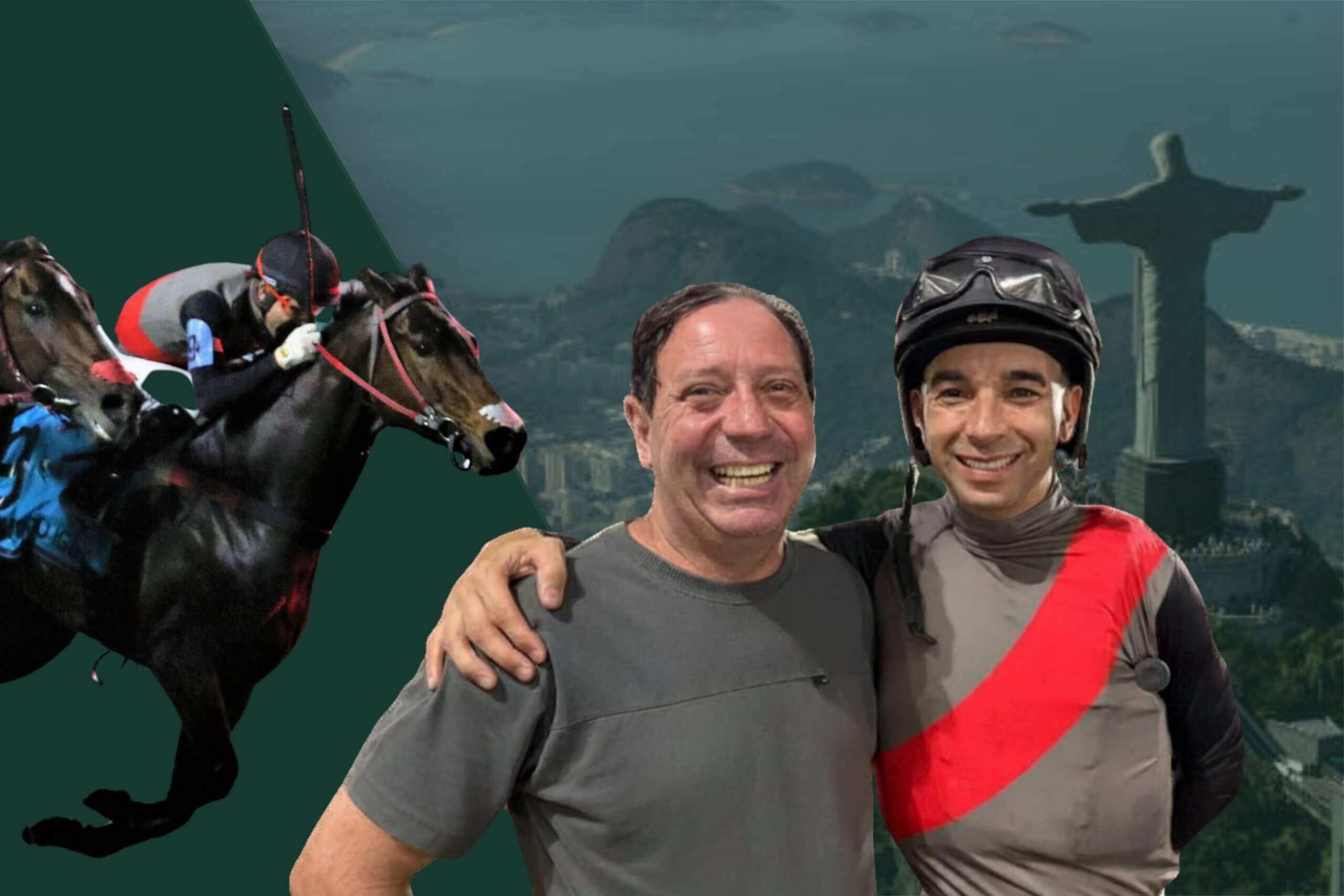
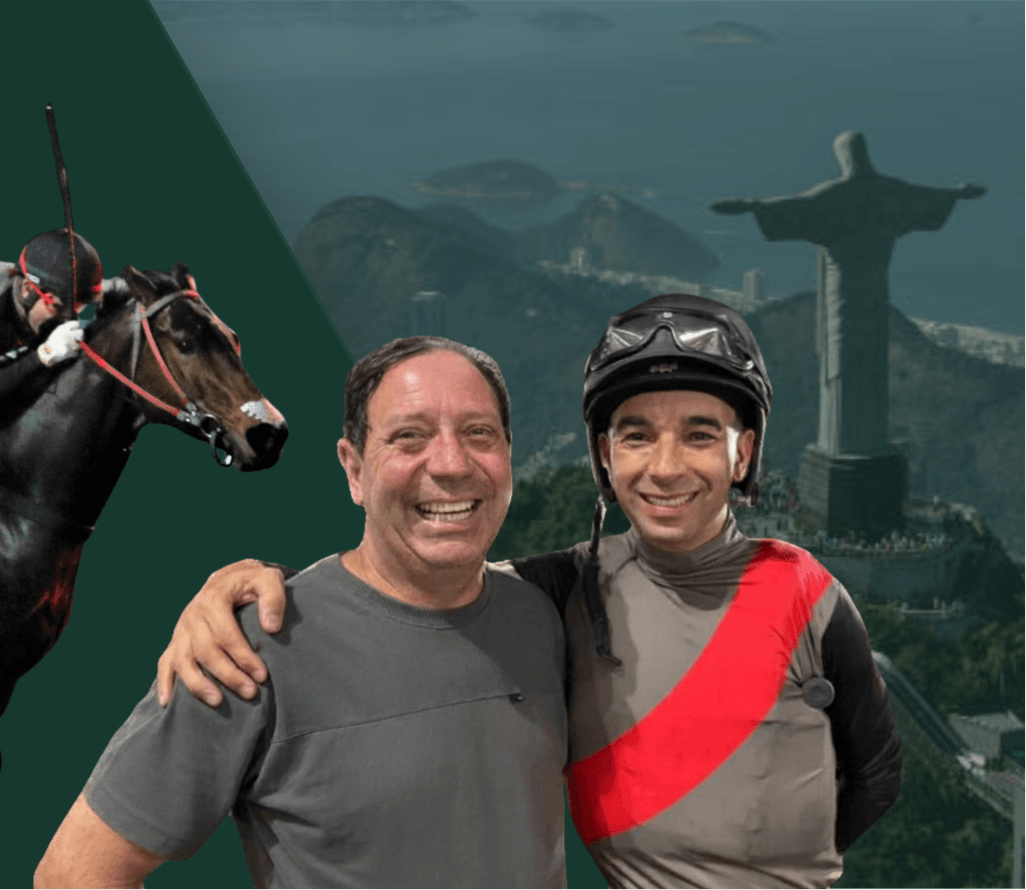
8 August, 2026JOÃO MOREIRA sits at a corner casa de sucos in Copacabana, a milk coffee and a plate of toast in front of him. Broad-leafed amendoeira, the umbrella-like trees that dot the sun-kissed streets, throw a light and a shifting shade across the mosaic pavements. Around him locals lounge over bowls of açaí dusted with guaraná, in no hurry on another sunny Sunday. It is mid-winter in name only – shorts and t-shirts, headed for a top of 27 degrees celcius.
The night before, he won a Group 1: Brazil’s best race over 2000 metres. First prize was 227,200 reais – about HK$347,870. Last season in Hong Kong, his mounts earned HK$40.3 million from just 193 rides. A good night at Happy Valley pays more than the biggest race in Brazil. In an hour he will drive back across the city to Gávea and ride again – this time for a few hundred people, for prize money that wouldn’t cover a Hong Kong jockey’s post-race dinner tab.
So: why here?
Moreira doesn’t reach for anything about the soul of the sport. He talks about the owner – a gas-station man from Paraná he wants, more than anything, to do well. That is the whole of it. But nobody here, he says, does this for the money.
To believe him, you had to be there the night before.
Gávea does not look like a racecourse in decline. It looks like a palace someone left by the sea.
The grandstand is a century old, thrown up the year the track opened in the French style of the day – marble stairs, mosaic floors, wrought iron faded to the soft green-grey of old money, long banks of slatted wooden seats worn smooth by a hundred years of racegoers. High above on the Corcovado, Christ the Redeemer stands with his back to the place, arms thrown open to the bay and the postcard city on the far side of the mountain; the racecourse lies behind him, in his shadow. Cats move through it like little landlords, threading the rails and the flowerbeds, dozing on warm stone.
On the big night it fills. This is the Copa dos Criadores – the breeders’ championship, Brazil’s answer to the Breeders’ Cup: seven black-type races, three of them Group 1s. The gates are open, entry is and free. Behind the old stand, a line of parents and children runs back 200 metres, waiting on pony rides around the leafy sprawl of the pre-parade ring. Racing here has had its lean years. Tonight the crowd is young and the mood is hopeful, and the eyes still go where they should – to the horses.
The best race of the night belongs to a tiny filly who should never have made it to a racecourse at all. “The best horses,” Moreira says, “they’ve always got a story.”
Summer do Iguassu was basically a giveaway. Her owner reckoned the mare she came from was worthless and let her go; Moreira’s boss took her on. The foal was born on the farm, fell into a drain, and got stuck there, badly hurt. They saved her, barely – a new vet spent a month just working out what was wrong before anyone could put it right.
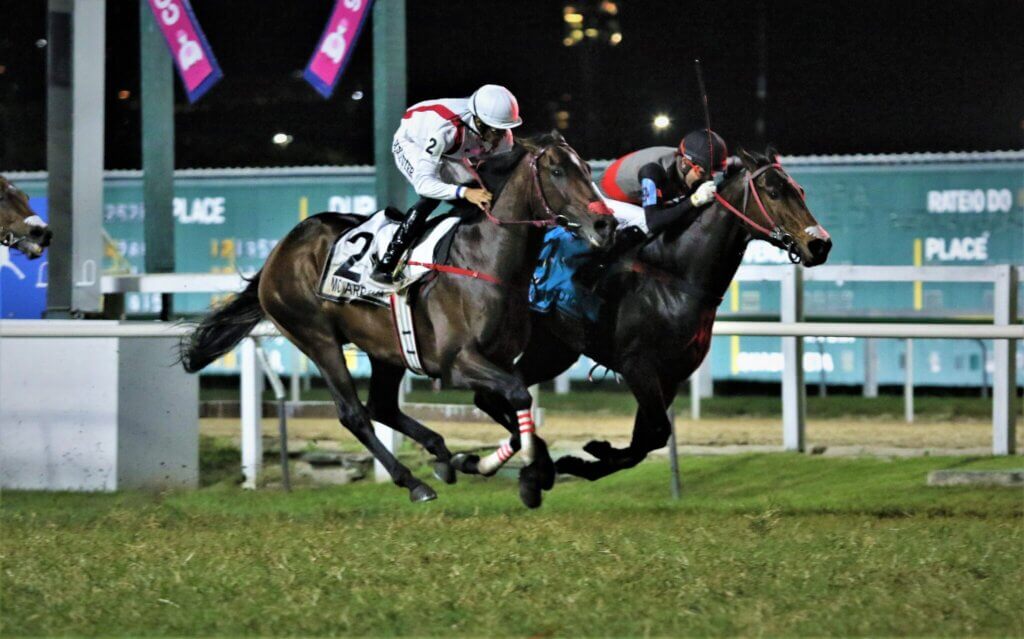
She has been fighting ever since. And in the straight, under lights, she does not look like a winner. She looks beaten – a rival surging up outside her, the race gone – until the final desperate stride, when something in her refuses it, and the post arrives in time. Racecaller Thiago Guedes’ voice rings out across the evening and cracks into disbelief.
Then Moreira is off her back and the composure is gone. His cheeks are wet. He holds the trainer a long time – a small man in a plain t-shirt, no jacket, no idea what to do with a camera pointed at him – and the trainer holds on back. Moreira points at him.
“This,” he says, “is the hardest-working person I know in racing.”
His name is Antônio Marcos Oldoni.
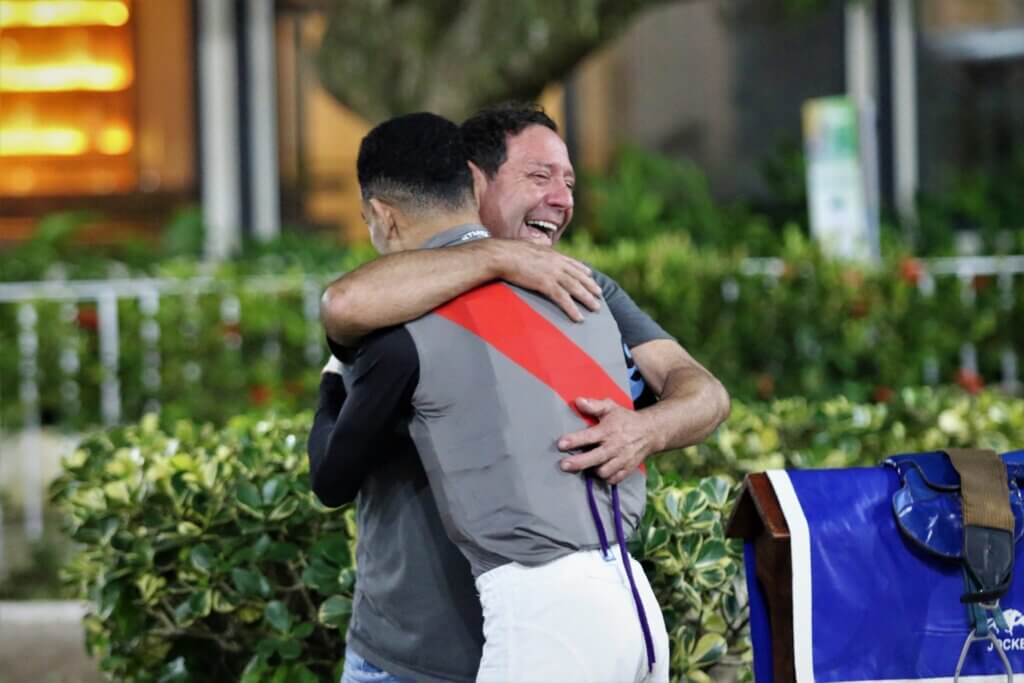
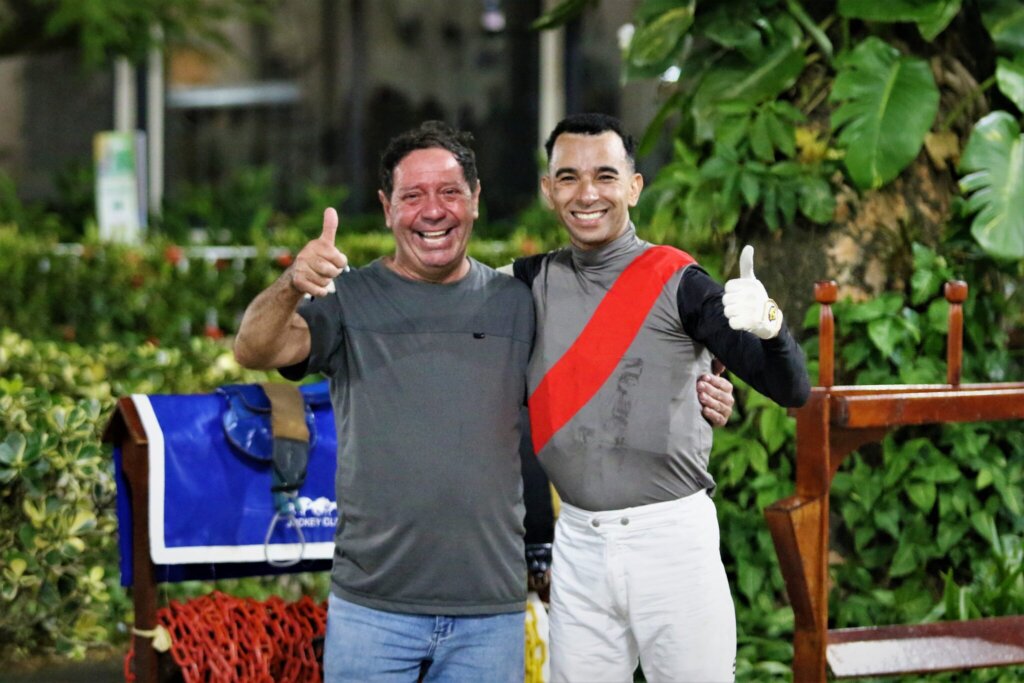
Later that evening when Oldoni’s name was read from the stage as Champion Trainer for the first time in his life, he was not present. He does not go to things like that. He is happier in a stable than anywhere a jacket is required, and when the award was announced he was, as far as anyone knew, at home asleep.
He has worked with horses for more than 30 years, most of them as an assistant, and he came up the humblest way there is – through the cancha reta, the straight-track quarter-horse racing of the interior, before he ever went near a thoroughbred. He became a trainer only about five years ago, when his long-time mentor A.B. Pereira died of Covid, and the stable fell to him. He trains 30 or 40 horses for one owner. By the national numbers, he is nobody.
Which is what makes the year absurd. That one small yard won eight Group 1s and, with its stable star Obataye under Moreira, took the Gran Premio Latinoamericano – the biggest race on the continent – and the Carlos Pellegrini in Argentina. Oldoni did it all from Curitiba.
You need the map to feel how unique this is. Rio, at Gávea, is the capital of what’s left – beautiful, cautiously optimistic, still good for 10,000 people on its showpiece night and maybe a thousand on an ordinary Sunday. São Paulo, richer than Rio, the city you move to if you need work, has seen racing rot: the stands at Cidade Jardim for years were all but empty, the land beneath them worth more to real estate than to racing – the saddest and most common story in the modern sport.
There is a glimmer down there in São Paulo now, talk of new money, a partnership with a major bank and new, young management with energy and ideas, willing to pay the prizes again. In recent months there has been hope – the new management opening the gates, bringing back families during the vacation season. July saw crowds of 3,000-plus. The champion trainer of the whole country works out of Curitiba, down further south still – from a track, Hipódromo do Tarumã, run by the Jockey Club do Paraná, that barely registers on the national map.
“You can’t get more dedicated than him,” Moreira says of Oldoni, back over the coffee. The man can barely work the Jockey Club website to enter a horse – the paperwork beats him – but he has been in the yard every day for three decades, and he can tell you the courage and the temperament of every horse, and every one of its pedigree page too. He loves horses in a way that costs him. When it’s time to move one on and bring new blood through, he can’t do it; he’d sooner train eighty than let one go. It falls to Moreira, sometimes, to be the one who tells him: let this one go, it can’t win any more.
The owner is Paulo Pelanda, who took his late father’s fuel business and built it into some forty petrol stations, one of the three biggest operators in his state. He keeps around 300 horses. On paper it is madness.
“He just loves it,” Moreira says. “He loves the game. He’s got no reason to have horses – from a business point of view it’s a hundred-per-cent lose. But he doesn’t care. His father was a breeder, he’s a breeder, his son will be a breeder.”
What Pelanda loves most, Moreira says, isn’t even the big night Group 1 racing like the evening before; it’s the old straight-track match races back home, two horses down a line, where he’ll put up a million reais a time just for the thrill of it. He does everything for the love of the game, and asks for nothing back – least of all from the jockey. Moreira says he never questions a ride, never calls to ask what went wrong. “He only ever tells me to do my best.”
Moreira says even a lucky, careful owner claws back maybe 30 per cent of what he puts in. A few, running a horse or two, might break even – if they find a good one and sell it. And the buyers come.
This is the low-key corrosive thread that runs through struggling jurisdictions with paltry prize money – even once-mighty industries like New Zealand and South Africa. The best three-year-olds Brazil breeds are sold before they turn four, most often to Hong Kong, where the prize money makes the offer impossible to refuse. Even Zucca Baby, who won the Grande Prêmio Brasil, was listed but didn’t line up in Saturday’s field: already gone. Moreira puts it bluntly:”We have no prize money,” adding, “So if you have a good horse, you sell.”
That is the fight but hard-working administrators like Mayra Federico, who runs the breeders’ and owners’ association, are pushing back where they can, at the track – starting with bringing people back to the racecourse.
“It used to be for the elite,” Federico says of the old days – closed, private, like a club, which is precisely what hollowed it out. The sport lost the public. So now there are pony rides and open gates and food stalls and a reason to bring the kids, free at the door except on the two dress-up days a year. On Saturday, 10,000 came.
There is one race Moreira has never won: the Grande Prêmio São Paulo. The last conspicuous gap on a CV that holds nearly everything else in Brazil and plenty more elsewhere – and he wanted it badly enough, last year, to fly overnight after a Kentucky Derby ride straight into São Paulo to chase it. It still got away.
Moreira rides retained for one stable now – no agent, no open book – and that stable is built on sprinters and young horses. The ones good enough to win him the race he wants most in São Paulo are exactly the ones sold to Hong Kong before they’re old enough to try.
He rides a fraction of what he once did, and he is candid about why. He has a young family at home in Curitiba, and he would rather be with them than chasing rides around the world. And there is the reality of a jockey’s body ravaged by a hyper-kinetic, crouching style that has worn his hips to the bone.
“I can’t keep riding forever,” he says – not mournfully, just as a fact, the way he says most things. It is less a countdown than a reason to want the right things now: to do well by the owner.
Moreira was once, not so long ago, the gravitational centre of the richest racing on the planet. Everything in this game tilts toward that money – horses and the people who work with them. He is one of the few things moving the other way and he knows the exact weight of what he’s turning down, because he had it in his hands.
But, he says, “a Group 1 is hard to win wherever it is in the world.”
He finishes the coffee. The corner is waking up and Hipódromo da Gávea – the track a local described to me as “a pista mais charmosa do mundo”, the most charming racecourse in the world, is only a short Uber away – back to the palace by the sea, under a clear blue sky, to do it all again. The first race is worth around HK$24,000 – the whole race, less than what fifth pays in a Class 5 at Sha Tin.
I asked Federico the day before, what a visitor ought to do in Rio on a day like this. “It’s winter,” she said – but in Rio, it’s never winter.
“Come to the racetrack on Sunday.” ∎