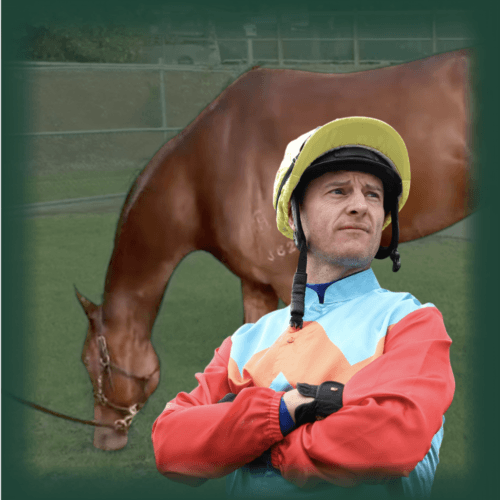
Ka Ying Rising was beaten in his final barrier trial before The Everest at Randwick on Tuesday morning, finishing behind Everest rival Ninja on a track rated Slow 7.
The Hong Kong sprinter, trained by David Hayes and ridden by Zac Purton, was asked for an effort in the straight in front of a large audience watching the livestream. Hayes’ assessment was that the horse was better than he was before last year’s Everest, but not at his best.
Shane Dye was at the track. He spoke with Idol Horse editor Michael Cox on the Idol Horse Newsdesk podcast about what the trial showed, how rain could change the race, and why he believes the pressure on raceday falls on Chad Schofield, the rider of Tempted.
This conversation has been edited and condensed for clarity.
Michael Cox: You watched the trial. What was your instant reaction?
Shane Dye: He tried all right, but it wasn’t great. He went better than he did last year, I know that, and he looked better in the parade ring. But he gets a bit lost out there. If you watch his ears coming around the turn, he doesn’t know where he is. It’s all new to him, which means he’s actually not doing as much as you think. He’s taking it easy. He doesn’t seem to trial great there, but it was definitely better than last year.
Reading The Ears
So the ears moving around tell you he isn’t fully concentrating. What does that say to you?
When a horse is moving its ears, it’s a good sign they’ve got more energy. They’re having a look at things; they don’t know where they are. So they’re not going as bad as you think. But when Zac clicks him up on the outside, there doesn’t seem to be a lot there, last year and this year, whereas in Hong Kong he just dashes clear in a trial. He still won last year. I think he really needs a good track.
Long Grass, Same Track
The track was rated Slow 7 after rain, and the grass was long because they haven’t been able to get on to cut it. How do you weigh the performance against those conditions?
I heard David say the grass was long, but they’ve all still got to run over it, haven’t they? He’s not the only one.
The Rain Question
The grass will be much shorter on raceday. What matters most for him then?
Tempted is a very, very good horse. There’s no doubt about that. If it’s a heavy track, she really comes into it. If it’s a good track, he’s got two to three lengths on Tempted, and Tempted’s got two or three lengths on the rest of the field. That’s the way you line it up. But on a wet track she could bridge the gap, because we don’t know what he’s going to do on a very heavy track. It takes your brilliance away most of the time. David says he’s seen him trial on a wet track overseas and he loved it, but trialling on a wet track isn’t the same as racing on one, because there’s no pressure.
Blue Door And The Speed In The Race
Blue Door, a three-year-old filly carrying a light weight who races on the pace, has come into the field. We’d talked about an Everest with no speed. Does she change things?
No, not really, and she shouldn’t for Zac. He can either take a sit, or if Blue Door misses the start or doesn’t want to go as quick as you think, he can lead. Normally in an Everest you’ve got six or seven that want to be in the first three. This year I think there’s only two or three. If I was wanting a barrier, I’d want to draw out a little bit, so he has time and room to be where he wants. But if he draws low, he’s got that much natural pace, and Zac’s so good on him early, that it makes no difference.
Not His Best Game
Zac noted his recovery was a little slower than usual. He had a good blow. There’s one more serious gallop on Friday. Do you need to see anything from him there?
I don’t need to see anything. I don’t think anyone does. We all know what he can do. But I’ll tell you something now: he doesn’t bring his best game to Australia. There’s no risk about that on that trial.
David’s comment was “better than last year, not his best.”
That sums it up. He looked better in the parade ring, he didn’t sweat up as much, and I thought his action was better than last year. Last year I put him up on my screens against his runs in Hong Kong, and he wasn’t striding as freely as he can. Even in the Everest last year, if you watch him at the furlong, he normally takes a huge stride, and he wasn’t. That’s why he never got away from them. He wasn’t at his best.
Why The Trial Result Doesn’t Matter
This might be the most scrutinised barrier trial there has been, live-streamed to a huge audience. For a less experienced trainer or jockey, the temptation would be to ask for more and reassure everyone the horse is 100 percent. Have you seen that happen?
Zac definitely tested him this morning. There’s no risk about that. He pushed him out, and the other horse, Ninja, trialled a little bit better. That doesn’t mean he’s going to beat him on raceday. Last year Ka Ying Rising got beaten in his trial, ran third, and then came out and beat those horses in the Everest. Where they finish in a trial is irrelevant to raceday. If he improves the way he did last year, he’s going to win. He’s too good. He’s a freak.
But as I keep saying, he does not want a heavy track, because that brings Tempted into it. We’ve seen what she’s done on wet tracks, and we haven’t really seen Ka Ying Rising on a very wet track. You’ve also got to remember she goes up in weight from last year, which is a lot. Has she improved? Of course she has. But is Ka Ying Rising going better than last year? One hundred percent. So it’s just not enough.
Chad Schofield’s Dilemma
Say it’s a dry track. If you’re Chad Schofield on Tempted, what’s your game plan?
Let me talk about pressure on a jockey. If I’m riding Ka Ying Rising, there’s no pressure. Just none. You’re going to jump and lead, or be second or third outside the leaders. I know what I’m doing. The pressure is on Chad Schofield. He has to decide whether to put Tempted in the race and sit closer, to follow Ka Ying Rising and give himself a chance to win. If he does that, there’s no doubt she can’t finish as well as she normally does, because she’s burning energy early. But mathematically, it’s the only chance you have of beating him.
The other option is you ride her normally and go back. She’s got unbelievable finishing sectionals, and she will hit the line, but Ka Ying Rising’s sectionals are just as good, and he’s going to be seven lengths in front of you. It’s mathematically impossible to beat him that way unless he has a bad day and doesn’t run to his best, and we’ve never seen that happen in his career. So it all depends on barriers. If Tempted draws wide, you’ve got to go back. You can’t press forward, because you’re burning too much energy. If she draws in, you might say, right, I’m going to gamble and ride her a bit closer.
When 1200 Becomes 1300
Does a wet track change how he rides her?
One hundred percent it does. If it’s a wet track, I’m not going forward on Tempted. We’ve seen what she’s done on a wet track coming from the back. You’re gambling that Ka Ying Rising won’t handle it as well and won’t be able to get away from you at the 300 and put seven or eight lengths on you. If you go forward on a heavy track, it can take her sprint away. And 1200 metres becomes 1300 metres on a wet track. It’s further, even though it’s classified as 1200, because you’re putting pressure on the horse early and you’ve got to get through the wet going.
It also depends on how the track’s racing on the day. Is it leader-biased? Are they coming down the middle? On a lot of wet tracks they come out wide. By the time The Everest comes around, they’ll know the best part of the track, and when they go into that race, they’ll know whether they’re going back, forward, in or out.
Listen to the full conversation on the Idol Horse Newsdesk podcast, and read Shane Dye’s Idol Thoughts column at idolhorse.com. ∎