Cherie DeVaux: Suddenly Famous
The first woman to win the Kentucky Derby speaks to Idol Horse about processing that historic achievement, the media whirlwind, pitching at Yankee stadium, and the determination that spurred her through a tough start.
Cherie DeVaux: Suddenly Famous
The first woman to win the Kentucky Derby speaks to Idol Horse about processing that historic achievement, the media whirlwind, pitching at Yankee stadium, and the determination that spurred her through a tough start.
2 June, 2026YOU’VE GOT TO be somebody to throw a first pitch at Yankee Stadium. Sure, everybody is somebody, but not everybody is the kind of ‘somebody’ that gets to walk up to that famous mound in The Bronx and throw that ball of handstitched white cowhide into the catcher’s mitt.
George W. Bush threw it in 2001 as U.S. President – the first game after September 11 – and the list of high achievers handed the ball and the ceremonial honour this year alone includes the legendary boxing champion Manny Pacquiao, Olympic gold medal winners Jack Hughes and Aerin Frankel, and two-division UFC champion Alex Pereira.
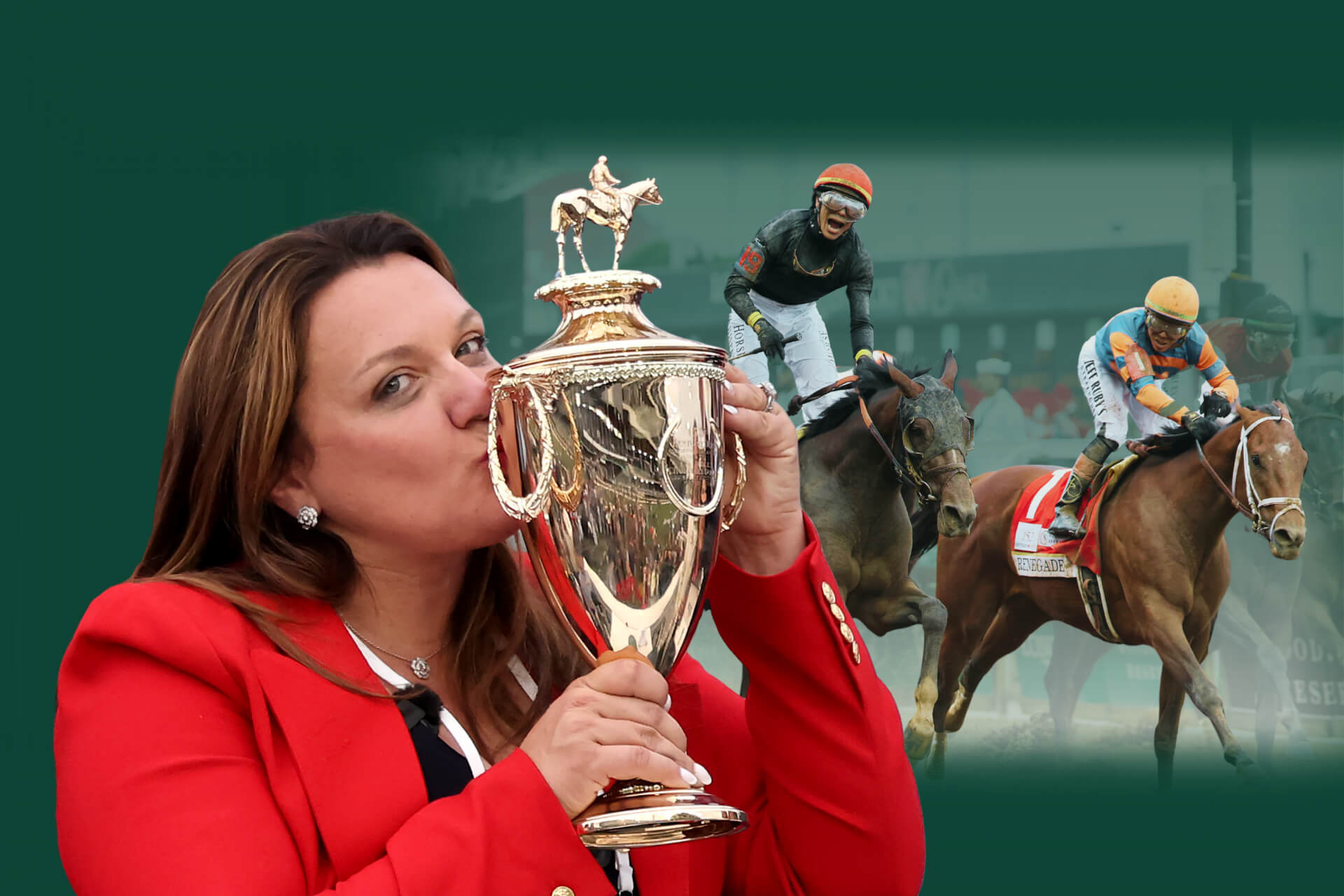
Cherie DeVaux wasn’t that kind of somebody before Race 12 at Churchill Downs on May 2. After it, she was top of the list to throw the first pitch at Yankee Stadium five days later, alongside Jose Ortiz. Race 12 was the Kentucky Derby, after all, and DeVaux had just made history as the first woman to win the race; Ortiz had piloted her horse, Golden Tempo.
The pair walked out to the pitcher’s mound wearing the number 71 jersey, the Yankees squad number of Ortiz’s second cousin, rookie pitcher Elmer Rodriguez. The pressure was on: the rollcall of bad celebrity first pitches in Major League Baseball is stacked with famous names and in New York alone it features awkward moments for rapper 50 Cent at the Mets and the great tennis champion Serena Williams at the Yankees.
“I got hustled,” DeVaux tells Idol Horse. “They let me know on Tuesday that we were doing it Thursday evening and I had a busy Wednesday; Jose plays baseball with his kids every day, and I’m like, this is not fair,” she laughs, “Not fair at all.”
50 Cent’s infamous throw was so wide the commentator couldn’t help but say with a dry cut of his tongue, “That was more like 2 Cent,” and Williams’ pitch at the Yankees’ grand old arena at 1 East 161st Street went high and wide, prompting the notoriously tough New York crowd to groan and the announcer to chuckle into his microphone.
“I played softball most of my young life into college, so I was more saying to myself, I hope I don’t embarrass myself,” DeVaux says. “But then you go up there and it’s like, okay throw the ball, and you’re like, ‘wait a minute, I wasn’t,’ … I just kind of chucked the ball I wasn’t even…”
She trails off as she recalls the baseball lobbing up in the air and dropping a foot short in front of the catcher. It was respectable, the line was right, no shame. But you can tell she has a niggle of regret that it wasn’t all the way there; beside her, pitching in tandem, Ortiz let fly a smooth ball that winged all the way to lodge sweetly in mitt.
“My brothers are making fun of me because I used to torture them with throwing as hard as I could and hurting their hands,” she says. “They were like, ‘You took it easy on that guy.’ But I didn’t need to throw it and have it go over his head or something.”
Cherie DeVaux’s name, what she looked and sounded like and what she did, would have gone over most people’s heads before the 152nd Kentucky Derby. That changed when Golden Tempo won the ‘Run For The Roses,’ the one race that most Americans have heard of and the one sports fans in the rest of the world might pay some attention to.
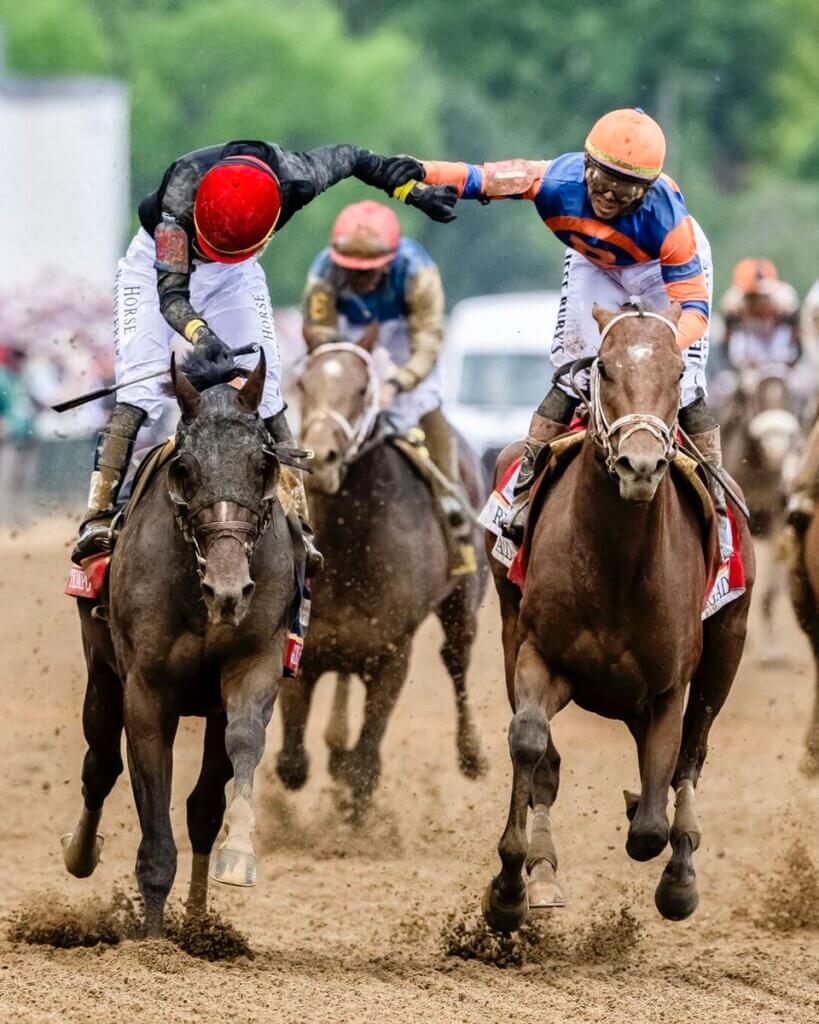
As Jose Ortiz rode the colt from last to first, DeVaux shouted over and over, “Come on Jose,” bobbed up and down, slapped the hard surface in front of her, pounded it with her fist, shouted louder, jumped higher, hit harder, went almost to her knees, hand on mouth, as the emotion reached crescendo and then exploded in embraces and high-fives.
In this age of instant digital reactions and interactions, there was a camera right in front of her, cameras behind her, above her, beside her. Video captured the hard-to-believe instant from all around, and in no time at all, DeVaux’s raw, high-energy moment was across social media, broadcast on news bulletins, and posted to YouTube for several hundred thousand people to watch and watch again and again.
“I had a lot of confidence, but realistically, people do not win the Derby on their first try,” she says with a knowing laugh. “My goal was I just wanted Golden Tempo to continue to improve, I wanted to have a good showing of himself and come out of that safe and healthy. But that’s when, in my wonderfully videoed acting-like-a-crazy-lunatic, when I stopped cheering, I just couldn’t believe that he was going to win the race.”
That moment was only the start. Cherie DeVaux as a Google Search term was about to expand in a way she could never have conceived of. And by the time she got the call from the Yankees, she had already had a “whirlwind” couple of days on what looked from the outside to be a non-stop media carousel of TV appearances and podcast slots.
DeVaux seemed to be everywhere. Monday morning brought a prime appearance on America’s number one (or two, depending on the metric) breakfast broadcast, the Today show, then she was off to the CBS News studio for another mainstream live interview. She did the Rich Eisen show on ESPN and the Dan Patrick Show, her story was carried in the New York Times, London broadsheets and so on. And that’s without getting into the weeds of all the specialist horse racing media interviews.
“Well, during all of that I had the luxury of being exhausted,” she laughs and reveals somehow she has missed only one morning with her horses, which, she emphasises, always come first.
“You’re just going through it: not in a bad way, it’s just it was a lot, it was overwhelming, but I’m still very much processing the enormity of it; like, that’s all the aftermath, but really I’m just still trying to process that we won the Kentucky Derby. It still kind of sounds foreign coming out of my mouth.
“But one thing I do hold – all of this is great and accolades are great, but what is really special has been the respect and the support of my peers, those that really do understand what we put into this and what it takes to get a horse to win a race like that. So that’s really been the biggest … I don’t know if surprise is it, but that’s really what I hold close to my heart.”
DeVaux’s story has been told often in the last four weeks. Her family’s Standardbred operation in New York, the move away from that world to south Florida when she was nine; the college years, her parents’ move back to New York and the connection with racing through a summer job at Chuck Simon’s barn; the assistant trainer years with Chad Brown, working with elite champions like Lady Eli. Then setting up under her own name.
“When I worked for Chad, I was, I think, 28 years old and I made the decree that it was going to be my last assistant trainer job and wherever that led me was what I was going to do,” she says and the firmness of her determination is evident in her words.
“Anything in my life, I don’t do anything except at the top level. Anything in my life, I want it to be at the highest level.
“When I was assistant to Chad, I was introduced to the best of the best horses at a high level, not just one here and there, it was a high quantity of them throughout my whole time working there. So, when I decided to be a trainer, and my husband’s the same way, he’s a bloodstock agent, we wanted to be at the top level.”
So that was the dream and the aim back in 2018 when DeVaux saddled her first runner, Take Charge Tina, fifth in a Belmont allowance race on May 18.
“For the first couple of months, I was the hot walker, the groom, the pony rider, sometimes the exercise rider,” she says. “We went from zero to about 12 horses the first year and then 24 and then 40 and then we’re at 120 right now and that’s about where we’re comfortable being as far as the number of horses in the stable. We have 90 plus employees now.”
But it was a long period of work for little reward before she had her first winner. It came at the end of March 2019, the year after she started – a horse called Traveling, in a Gulfstream Park maiden claimer. It felt like an age. Pressures. Disappointment. Those early days were tough.
“It took me about 11 months to win my first race, so you could take almost a whole year and say that I didn’t even win a race in that first year,” DeVaux says. “The first couple of years were really trying on me, mentally.
“I’ve always been a hard worker. I’ve always had a strong constitution when things go, you know, when you’re down, you’ve got to keep going forward. But never would I have dreamed that in a relatively short amount of time we would be at the level we are now.”
She credits her husband, bloodstock agent David Ingordo with imparting understanding and calmness, as well as a supportive and sensible way to cope with the challenge of those early days.
“David was the one that said, ‘Let’s just see, give yourself three years, don’t panic, let’s go three years and at the end of three years, we’ll reevaluate if you want to do this or not or if it’s successful.’” DeVaux says. “It was the summer going into my third year when we started winning stakes races and everything just fell into place going into that year.
“We have lulls in our stable, but this was all as we were trying to build our stable – you’re restarting. It doesn’t matter who you worked for, what you’ve done in an assistant trainer role: when you’re a trainer, you have to start over and it was very difficult. I kind of was almost oblivious, just couldn’t even think about it. Just keep going into work. Keep doing what’s worked for you, for me, the whole time.”
That mindset took her from struggling rookie to Kentucky Derby winner in eight years. And between times there was the G1 Breeders’ Cup Mile win with More Than Looks in November 2024 and the G1 E P Taylor Stakes victory last August with She Feels Pretty.
Not bad going for someone whose initial aim in her youth was simply to find a way to work with horses. Thoroughbreds weren’t even on her radar back then.
“I grew up in the barn,” she says. “When my parents moved us to Florida, they had gotten out of that (Standardbred) business, but I’ve always had horses in my life, so I’ve always ridden horses, I used to compete in rodeos.
“I was never introduced to thoroughbred racing, I was like the casual fan that just watches the Kentucky Derby … maybe … but usually was in a rodeo on Saturdays. I’ve always wanted to have horses as part of my life. That was my goal. I wanted a job that could afford that. That was my goal when I first started college.”
When her parents moved back to New York and she needed a summer job, that’s when the hotwalking at the Simon stable came to be.
“And the rest is, as we say, history,” DeVaux says.
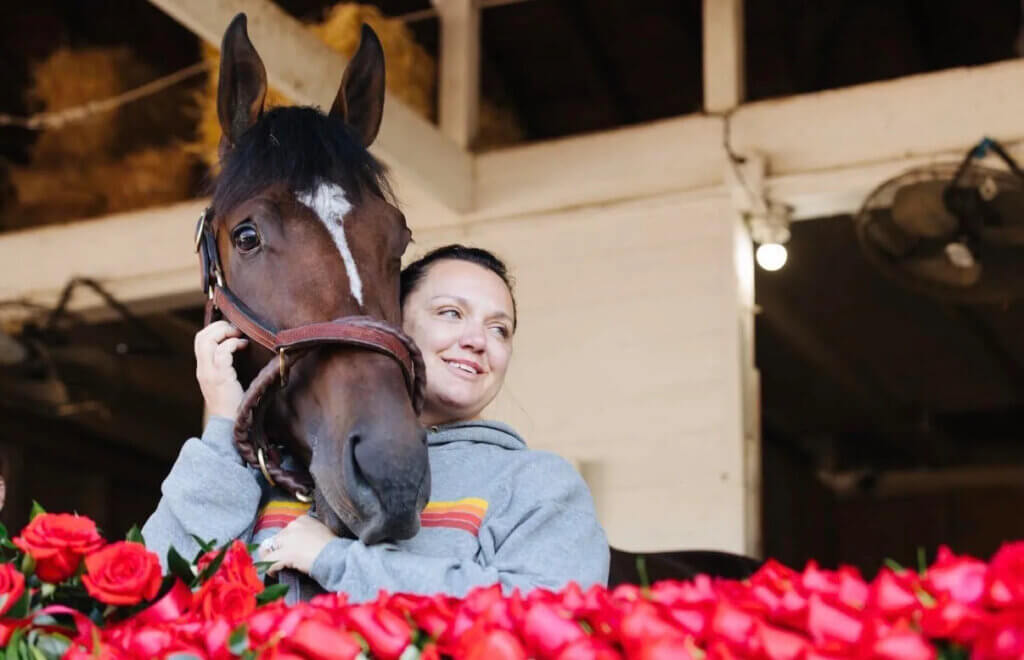
History in the making, that is, and it’s that element, being the first woman to achieve victory in America’s greatest race, that thrust her so suddenly into the spotlight of mass public interest. It’s something she appreciates deeply, yet it sits a little uncomfortably, too, for someone with such a focused, competitive, professional mindset.
“I’m going to try to say this without sounding like a bitch,” she says, grasping for the right words and tone to convey the complexity of thoughts and feelings around her achievement and what it means.
“There was a lot made about what would it feel like to be the first female to win the Kentucky Derby. And right when I went back to the press conference afterwards, I think it was the first or second statement that I said was ‘Thank God I don’t have to answer that question anymore.’
“It’s not what I set out to do: I’m a horse trainer, I want to be the top horse trainer. I happen to be female. It is a part of history, it’s something that I am profoundly grateful for that I get to be that person, but to me, it’s hard because it’s a little loss, that it’s a gender breaking moment for females.
“I feel special that I’m that person,” she emphasises, “and it’s not like I’m not going to acknowledge that or not acknowledge that it’s special. I’m respectful of being that person, but I am very much like, I’m glad that conversation’s over and we’ve put it to bed.”
She is also conscious that she has been part of a feelgood story that has cast the sport in a positive light and which has the potential to show the progress that has been made, particularly in terms of horse aftercare and the oversight of the Horseracing Integrity and Safety Authority (HISA), U.S. racing’s governing body, which she views as being steps forward for racing.
“There’s still a lot to iron out but our sport has come a long way in the positive direction,” DeVaux says. “If I can be that person, I want to be that person to talk about it and be a face that is positive for the sport; try to get it in a more positive light and be an advocate for what we have done, especially over the last five years, for a safer, fairer sport as a whole.
“There’s a lot of misconceptions, especially on social media, but there’s a lot more advocacy for aftercare, not as the end, in the beginning if a horse just isn’t gonna make it, there’s a lot more of that. And that used to be really hard because the aftercare wasn’t funded properly, but there’s been a lot of forward momentum.”
Before DeVaux went out to pitch that ball at Yankee stadium, Ortiz turned to her and suggested she could stand closer to the pitcher if she wanted to. But that’s not DeVaux’s style, she expects to stand shoulder to shoulder with her peers, men and women, on par, and give it her all.
“Jose was like, you can stand in front of the mound, I’m like no, I’m not going to be a pansy about it,” she says.
And in this whirlwind, which has taken her from relative unknown to ‘somebody’ beyond the horse racing sphere, to woman of the moment and an immovable place in sports history, standing on that mound was special.
“I grew up being a Yankees fan from my time in New York, so that was definitely the most amazing thing of everything I did after the Derby,” DeVaux adds.
“I’m grateful for all the opportunities and everything, but that was the, like, ‘holy shit’ moment.” ∎