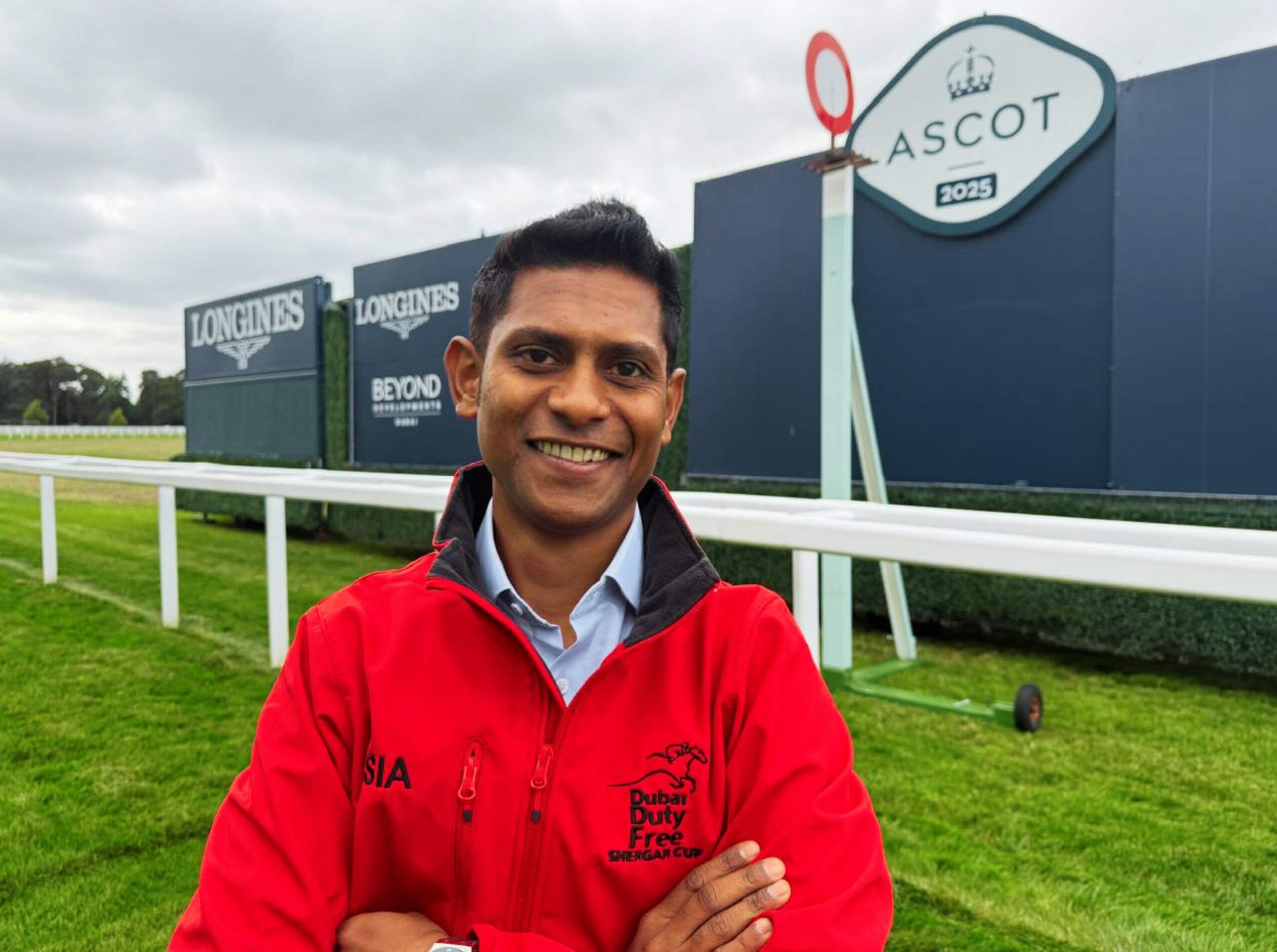
What do you do the night before you’re going to fulfil a lifelong dream to ride at Ascot Racecourse? Well, Suraj Narredu spent a good part of his night before in a hotel room balancing on a pillow. And why was he doing that, one might ask. Because he needed to practice a flying dismount, of course.
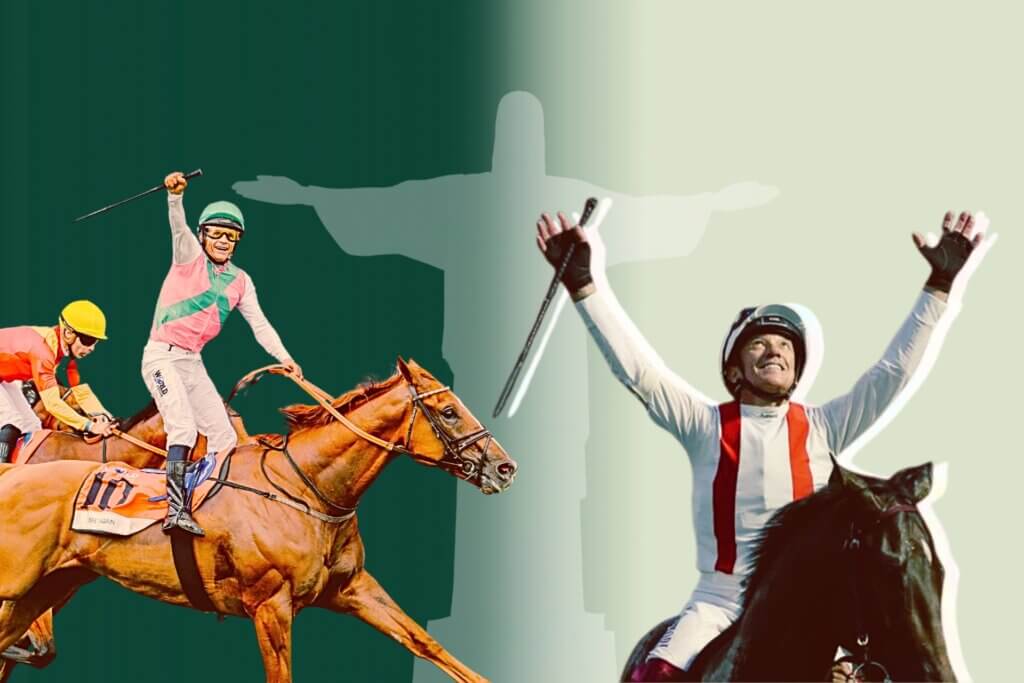
The thing is, leaping from a horse’s back was something he hadn’t ever done before. Yet there he was, a champion jockey, a big-race winner many times over, an elder statesman of India’s jockeys’ rooms, on the eve of the 2025 Shergar Cup, preparing himself – just in case – to pay acrobatic tribute to his longtime hero, Frankie Dettori, the great rider so synonymous with Ascot.
But Dettori’s famous flying dismount from the saddle was a trademark move tracing back to the Italian’s precocious youth. Narredu had just turned 40.
“I’d never done the Frankie Dettori jump in my life,” he tells Idol Horse, with a chuckle that says ‘what was I thinking?’ He feels the need to explain.
It was in the build-up, the day before the event, and Narredu was in the Ascot winner’s enclosure taking pictures with his wife. He turned to her, caught up in the awe of the place, and said, “If I win tomorrow, I’ll jump like Frankie because Frankie is my hero.” It was an offhand remark to the person he knows best; it was not binding.
But just moments later, he was interviewed by the media and a question was put to him.
“The interviewer asked me – how will you celebrate if you win a race? I said that I’ll do the Frankie Dettori jump if I win. Now, that was just like a casual statement, you know?” he says.
“The next morning, it was the headline in the newspaper. I’m like, my God. I was banging my head. What did I do?” he laughs again at the memory. “Until then, I’d never jumped off a horse, so that’s why I started practising the jump in my room from a pillow.”
The next day he was at Ascot, following in the footsteps of his uncle, Malesh Narredu, who rode at the Shergar Cup in 2009. Narredu was there to watch his uncle that day. This time, his uncle and father Satish, a former jockey, too, and other members of his family were there to watch him.
A leap from the saddle was only going to happen if he won a race. He had five rides in the competition, which pits 12 jockeys divided into four teams of three against each other, with points awarded depending on the finishing position.
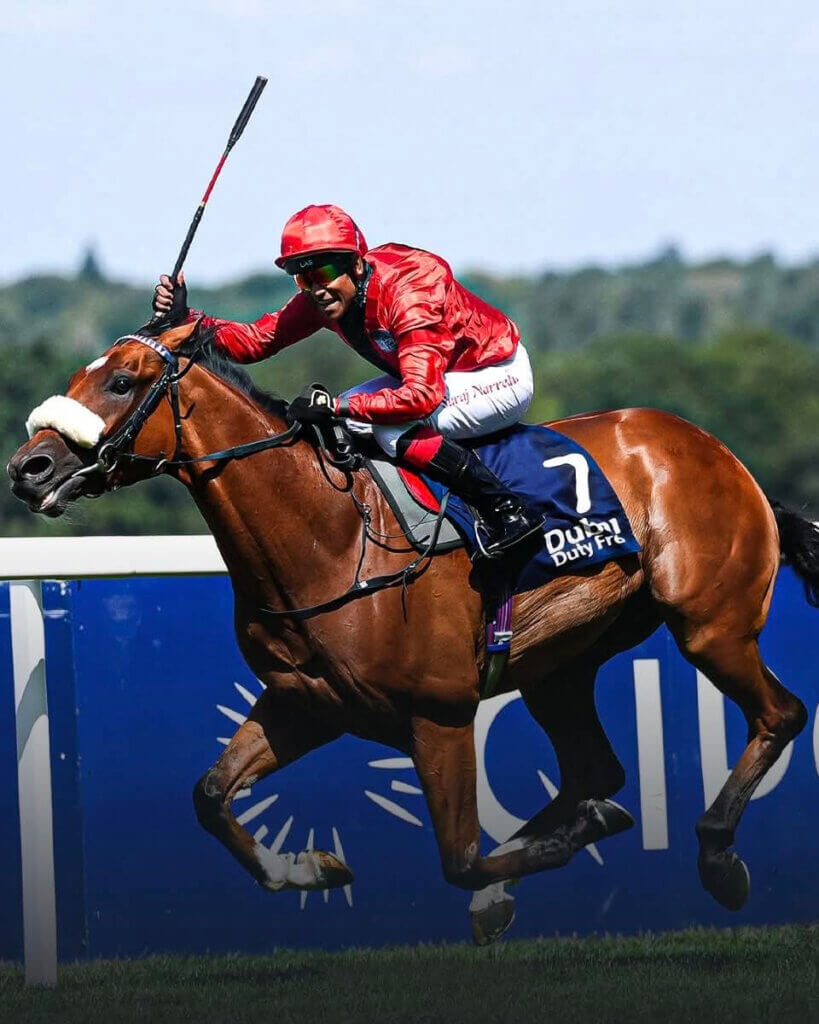
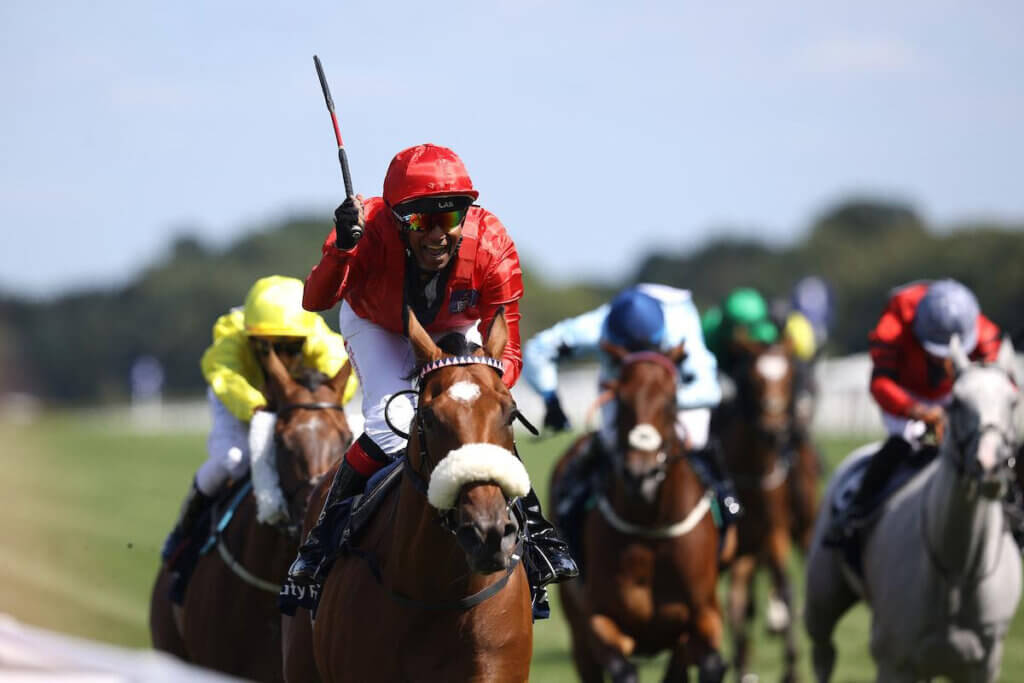
His first ride didn’t go to plan. The second wasn’t going as expected either, so he shook it up mid-race and made his own destiny. It was the two-mile handicap and up front Karis Teetan was setting a sleepily slow pace.
“The entire field was yelling to step up the tempo,” he says. “I said to myself, if I am to win this race, I have to outstay them, if it becomes a sprint, I am not going to win this.”
With about five furlongs to race he began to make his move, took up the running and stepped up the tempo.
“I was the first into the home straight,” he continues. “Now that was a big gamble because if I had lost that race, people would have said why was he in such a hurry? He could have probably waited. But technically, I knew waiting was the wrong thing to do. I had to do what was technically correct. I just took a bold decision.
“I thought, let me make the running from here and we’ll see: whatever happens, happens. Fortunately, I won the race. It was an outstanding feeling.
“You know, I can still feel that blurriness of thought that happened in the last 50 metres. The moment I passed the post, I was blank for quite some time. I was dazed, like what has happened? It was a very, very happy moment.”
But winning meant a flying dismount. Had he practised enough? Should he go through with it?
“I said to myself, no, come on now, this is my moment and I want to live it to the fullest,” he says. “Frankie has always said you need to celebrate the good wins and I thought that this was my moment. I needed to celebrate and I did a jump, which obviously was not 100 percent like Frankie. But for a first jump, I thought it was not bad. I kind of learned the technique at least. I said, next time I do it, it will be better.”
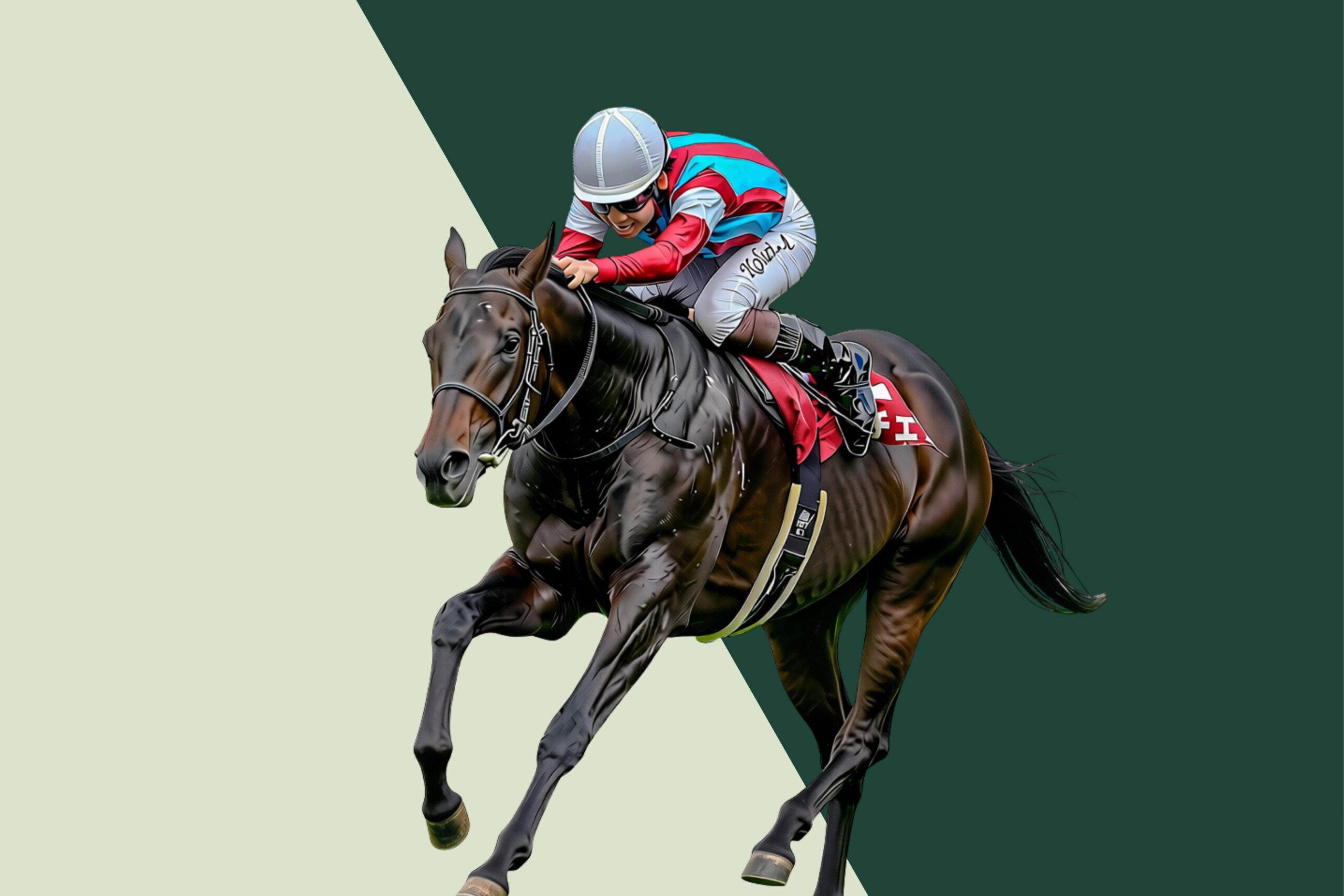
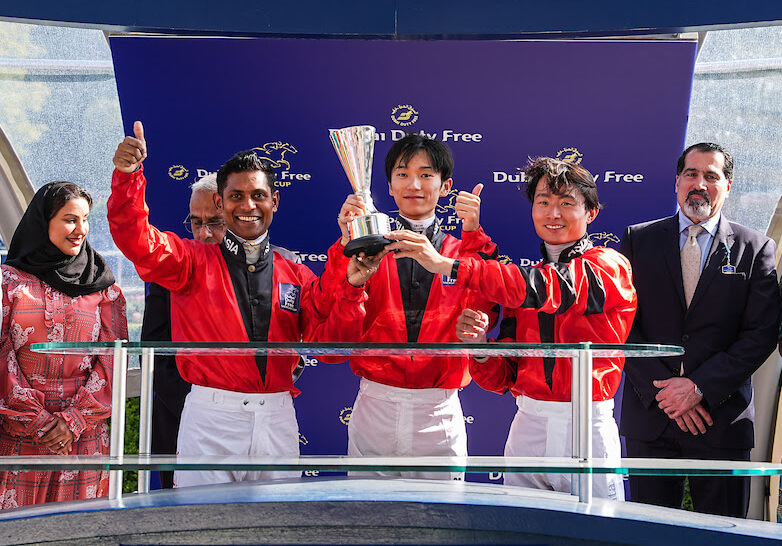
Narredu earned the ride of the day award for that win on the gelding Fireblade and also led Team Asia to the team title alongside two rising stars of the Japanese scene, the great dirt track champion Forever Young’s jockey Ryusei Sakai and Mirai Iwata.
He was invited back to Ascot for the 2026 Shergar Cup, but his flying exploits at his Ascot debut, allied with his younger Japanese teammates, evidently caught the attention of the Japan Racing Association (JRA), and this year he will also ride at Japan’s international jockey challenge, the World All Star Jockeys at Sapporo in late August.
If Ascot was a dream come true, riding in the JRA is next level: Japan and Hong Kong have long been the twin ‘holy grails’ for Narredu. He has applied to the Hong Kong Jockey Club – a number of times – and to the JRA to be considered for short-term licences, but without success. Indian racing is seen as second tier, the major races are not recognised internationally as real deal Group 1s and ordinarily he needs such wins on his CV if he is to get the call to either of Asia’s elite jurisdictions.
But back in March of this year he was riding in Calcutta when he received an email from Dr. Cyrus Poonawalla. The billionaire owner-breeder had been contacted by the JRA asking to reach out to Narredu. He responded and waited for the JRA to come back to him.
“I couldn’t believe it for the longest time,” he says. “When I got the final call to the World All Star Jockeys, it was fabulous, another dream come true.
“Recently, at the Derby meeting in Bangalore, I met a few delegates from the JRA, they wanted to visit me and see the races in Bangalore, and they opened a file and showed me an Idol Horse article in Japanese, and in the article, which was from last year, I had mentioned that I had great interest in riding in Japan, but I never thought in my life that line would make such a difference to my career. Then with my Shergar Cup teammates being Japanese … but I never had the proper channel to apply to ride in Japan, when I tried before I probably didn’t have the right contact details.”
He sees the WASJ as a potential gateway to earning a short-term licence in Japan. The competition rewards any top five finisher with qualification to be considered for a short-term stint riding in the JRA.
“That’s one of my targets, to have a winner and get into the top five in the points table and get a short-term license, at least to start off with, that’ll be great,” he says. “And at some point of time, I’m hoping and praying that even Hong Kong calls me to ride.”
Narredu has tried. He’s ridden spells in Macau and Australia previously, working to establish a profile outside of India while constantly learning and seeking to improve. He believes he is riding better than ever.
“I feel that I’m at a peak,” he says. “Since I’ve started riding more internationally and I’ve been having these short stints more in the last few years, I’ve also learned a lot of things, not only through experience of race riding, but also how to maintain your body and how much your body should be taking and how much you should be doing at a certain time.
“In India, people used to retire around 40. That was the trend and jockeys would become trainers or they used to put on a lot of weight, but back then fitness was never a criteria: they all used to just do their track work and races, and they used to be done with it. It’s not like that anymore.”
He says the race days are the easier days now, that it’s the three, four or five days between that are the hardest days.
“You keep pumping your body,” he says. “I love working out. I love playing my sports. I play badminton a lot and we keep playing different sports just to maintain that agility and have that kind of sharpness to take the split-second decisions. It keeps you really, really sharp in your mind and physically you’re very good. So, I would say that I’m definitely looking forward to riding the next 10 years if I can stay injury free.”
He says he has taken his preparation for the Shergar Cup seriously, maintaining his elite professional mindset with his fitness work, nutrition and sleep patterns. And he arrived in England a week and a half ahead of the Ascot event to acclimatise in Newmarket and get his mind in the zone, riding out for trainer Marco Botti.
Now, he is hoping for as good an experience as last year when he was also one of the most supported riders at the track. In fact, the level of support for him took organisers and Narredu by surprise.
“There are a lot of staff from India who work in different yards in England, “ he says. “At some point of time, they’ve worked alongside my dad and uncle, and the young ones they have been around me in India, they have seen me riding, or I know some of them personally.
“So a lot of people from all over the UK went to Ascot to see me and to support me. And I was quite surprised to see so many faces on the day: I never ever thought that I would see so many of them there.”
Those supporters gave one of the biggest cheers of the day. It was when Narredu made his bold move on Fireblade, switching off the fence and going around Iwata and Teetan to take it up approaching the home turn.
“If I watch the replay on YouTube, when we turn for home in the race, there’s a roar of the crowd when they see that I’ve taken over the running and I’m turning for home right in front. that roar you can even hear on YouTube,” he says. “It was so loud. It was a super, super kind of support.
“I know how big a moment that was not only for me personally, but for the entire country they were watching from. And I know there were a lot of people who wanted me to do it and they wanted me to do it for India.”
🇮🇳 2戦目はアジア選抜のナレドゥ騎手が勝利!
— Idol Horse (@idolhorsedotcom) August 9, 2025
🇬🇧 #シャーガーカップ 2戦目、長距離のシャーガーカップ・ステイヤーズ。ファイアーブレードが勝利、鞍上はインドのスラジ・ナレドゥ騎手。
🇯🇵 アジア選抜の一員、岩田望来騎手は人気薄ながら4着争いの健闘。#競馬 #海外競馬pic.twitter.com/CBdgY4mHeJ
Narredu’s bold move is indicative of the efforts he has made in his career to push out of his comfort zone and experience racing in different places. It has not always worked out, support has been limited at times, but he has a great belief in his ability and the ability of his fellow Indian jockeys.
“When I went to Australia three years ago, I went on my own,” he says. “I just wanted a different atmosphere to ride in because mentally and physically, I was a bit drained out and I needed some sort of change.
“The first one month it was very hard, even to pick up some rides, then things started picking up slowly and then I had my winners. It was great. Then I went to Sydney, I had a few winners. I think for the short time that I was there, I think I did well. And all of that probably helped me to get into the Shergar Cup, and now the jockeys challenge in Japan is happening, so the connection is happening.
“I’m hoping that I will have my chance in Japan and maybe Hong Kong, but still, we just need that shot. We need to get a chance.”
Ascot has given him his chance again, the JRA has given him a toe in the door. If things work out, perhaps he will get his chance in Hong Kong too.
But whatever happens, he will always have the memory of Ascot and the day he did his flying dismount; of Fireblade’s win and the roar of the crowd.
“I’ve won a lot of big races, but this stands out. I would put it on top of my list,” he adds. “It is probably the best moment of my career.” ∎