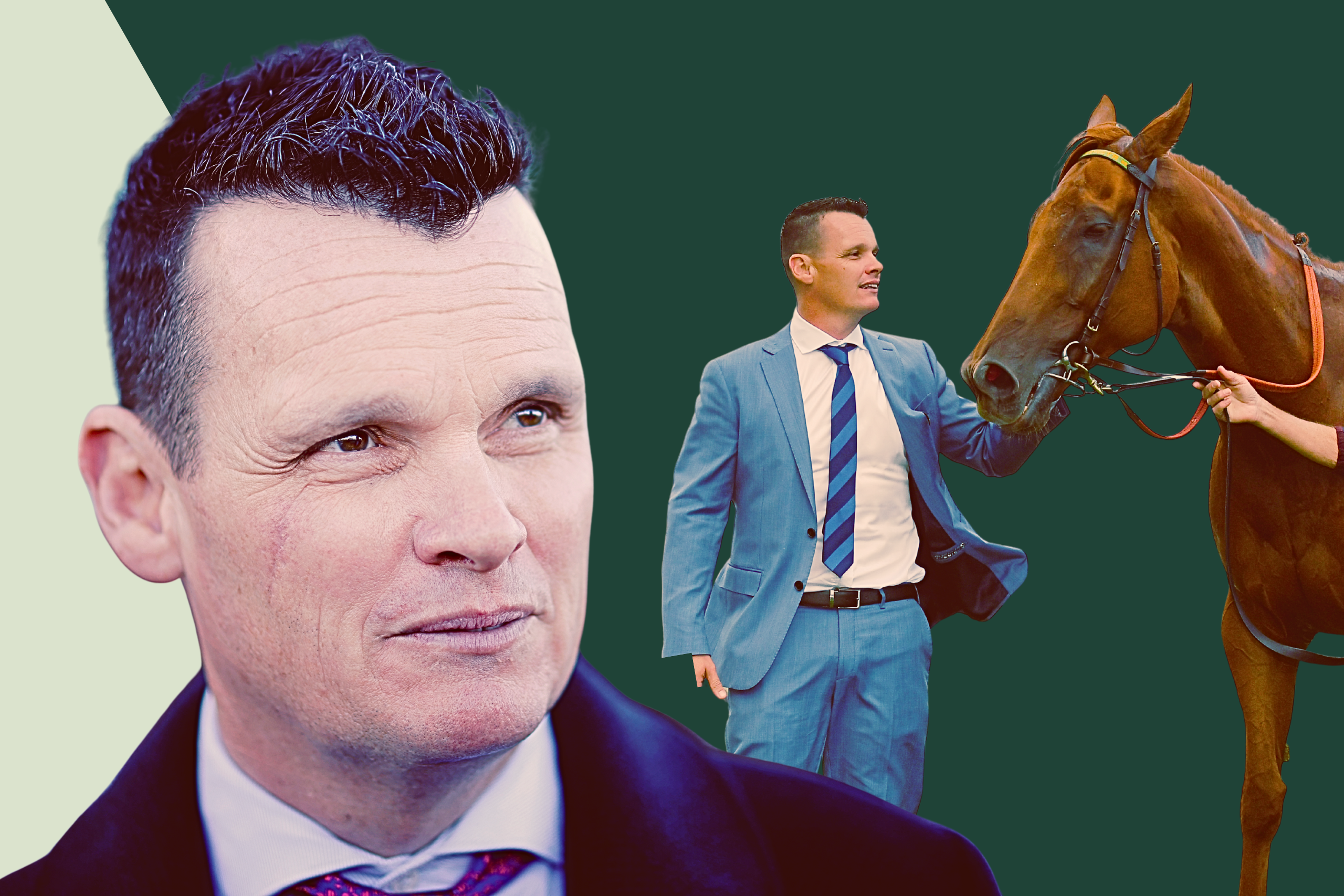
Written In Ink And Instinct: The Joe Pride Method
From tattoos earned by horses to a training philosophy built on the naked eye, Joe Pride has carved out a career – and a legacy – by trusting feel over fashion, patience over scale and self-belief above all else.
Written In Ink And Instinct: The Joe Pride Method
From tattoos earned by horses to a training philosophy built on the naked eye, Joe Pride has carved out a career – and a legacy – by trusting feel over fashion, patience over scale and self-belief above all else.
2 January, 2026IT TAKES A brave man to wear his heart on his sleeve, and no one could ever accuse Joe Pride of being a closed book. But it’s underneath his sleeves where his real story is told.
It’s rarely seen because as a horse trainer in Australia, Pride wears suits and long sleeve shirts to the races and in front of television cameras. But on a wet and warm early summer morning at his Warwick Farm stable in Sydney’s south-west, Joe’s pride and joy is permanently scribbled along the inside of his forearm.
Steps In Time.
For those with long enough memories, Steps In Time was the name of a good mare who raced in Sydney more than a decade ago. She mostly campaigned for John O’Shea before he took on the job as Godolphin Australia’s head trainer, but finished her career with Pride, who got her to win a long overdue Group 1 at her second start for him.
So, he walked through the door of the tattoo parlour. There’s nothing flash about the ink, just plain block letters.
And so are many others: Red Oog, Vision And Power, Sacred Choice, Tiger Tees, Eduardo, all etched onto his body because of what they’ve meant to him. They sit alongside a more elaborate illustration which is a nod to his beloved South Sydney Rabbitohs in Australia’s National Rugby League competition.
“Tattoos are funny things,” Pride shrugs. “It was a silly thing when I got the first one with Red Oog and then I just followed up with it. They’re mostly in places you don’t see. But they’ve earnt it. I haven’t got Private Eye yet and Ceolwulf might be the last one.”
It only takes a while in the company of Pride, along with his teenage son Brave, to realise the former psychology student – who would later study John Size and had no family to follow into horse racing – is one of the most intriguing characters in the sport, discreet tattoos and all.
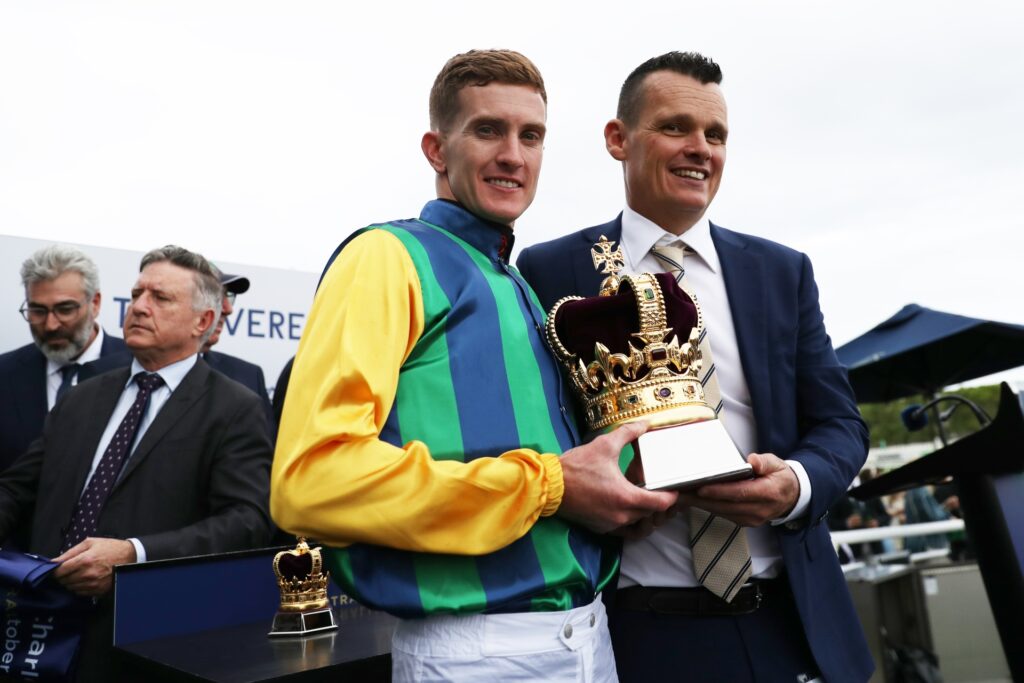
His career has seemingly been on a steady trajectory to the upper echelons, culminating with a wildly successful spring carnival in which Ceolwulf stamped himself as one of the best horses in the country with back-to-back wins in the A$5 million King Charles III Stakes. Ceolwulf’s form had been patchy for a year, but on the day of his biggest test, Pride applied blinkers to the gelding. Punters often joke there is no better gear change than when a Pride-trained horse has blinkers go on.
“I’ve got a few little different techniques I use and I certainly won’t be giving them away,” Pride laughs. “They’re a great bit of equipment for me and people can observe stuff from the outside and try to work it out.”
He doesn’t give away the whole secret sauce, but during a near hour-long interview with Idol Horse, Pride does help you work out what makes him, and his horses, tick, allowing him to more than hold his own against the mega-sized stables which have flooded Australian racing (Pride wants to have a yard which trains about 70 horses at any one time).
Pound for pound, is he the best horse trainer in Australia?
“I love hearing that,” Pride smiles. “It’s very easy to compare first grade footballers. But how do you compare trainers? Nearly impossible. Hypothetically, give them the same 10 horses and you might get somewhere there.
“We’ve trained more winners for Godolphin than anyone else at this stage (after they abandoned the private trainer model to spread horses around with public conditioners), and that’s probably as close as you’re going to get to a level playing field in racing.
“Anything else, how can you compare?”
A Size devotee, Pride has always fed his horses just once per day after morning exercise. Most trainers will fill up a feed bin twice with smaller portions, day and then night. He will gallop them less than the standard three times per week if he can, and over shorter distances. He wants to keep speed in their legs. The pool, he reasons, is a huge and underused asset by most trainers.
Data and analytics? He doesn’t dismiss it out of hand, but he’s not afraid to say he barely uses it either. Unlike the arms race from other stables to have horses in every corner down Australia’s eastern seaboard, Pride keeps all his at Warwick Farm. It means he can see them as often, or as little, as he likes.
“Where I’d like to think we’ve got an advantage, and I’m not knocking the bigger stables, I feel like we’re in a really strong position to analyse a horse because we don’t have horses everywhere,” Pride says. “They’re right there, under the one roof. I think it’s an advantage. It has to be an advantage.
“Mark Kavanagh said it once, ‘training is the science of the eye’. And I’m a big believer in that. It’s observing and following up on what I see. If I think a horse needs a gallop, I’ll gallop it. If data says it doesn’t, what am I going to do? Not gallop it?
“If a gallop isn’t any good and I had data that was telling me it was good, I still don’t think the gallop was any good. Normally, my instincts are more often than not correct. I’m not sure I need data to tell me that. I’d rather rely on what I see.”
His name is not etched on his body somewhere, but an old stallion named Periscope, which raced in the 1980s, might have been the most important horse in mapping Joe Pride’s future.
Pride wagged high school one Wednesday and, with a group of mates, snuck into the Canterbury track. There were far more people at the midweeks back then than the ghostly days of the modern era, where punters and online bookmakers mostly trade remotely.
Pride took $10 to the course. In the last, Periscope was being offered at odds of 100-1. For the place, he was 25-1. Pride had $2 on him to finish in the first three. Periscope scrambled into a placing.
“I was hooked,” he says.
Pride’s childhood was mostly spent around “desperate punters”. His family moved far, and often. Born in Queanbeyan just outside of Australia’s capital city, Canberra, Pride spent a lot of his formative years in the New Zealand city of Dunedin. His dad could get work in a variety of fields, but was mostly a plumber-drainer. “Dad had as many jobs as we did houses,” he says.
The family eventually returned to Australia and Sydney, shifting around the western suburbs, some areas of which are more socio-economically challenged than the city’s east. Pride wears it as a badge of honour when he calls himself a “Westie”, perhaps a front to mask his intelligence.
Having enrolled in a Bachelor of Arts degree at a Sydney university, Pride harboured a minor ambition of focusing on psychology because he thought he could earn good money. He quickly realised he cared little for human psychology, and also cared little for getting rich quickly. He had no family connection to the thoroughbred industry, but walked into some stables looking to earn some money, lured by the magic of horse racing in the same year Vintage Crop won the Melbourne Cup (1993).
“It’s an exciting sport, right? Once I worked out the animal is really good to work around as well, that was it,” Pride says. “At that time in the 90s, there wasn’t a lot of exciting jobs. But this had an intrigue about it.
“It’s gone now because I’m drowned in it, but back then it had a real mystique about it. I was so interested in the good horses – and there were a lot in that era. Maybe it’s me remembering it fondly, but I’m not too sure racing had many better eras. It was the classic blend of the old stuff, but it was modern enough to be televised.”
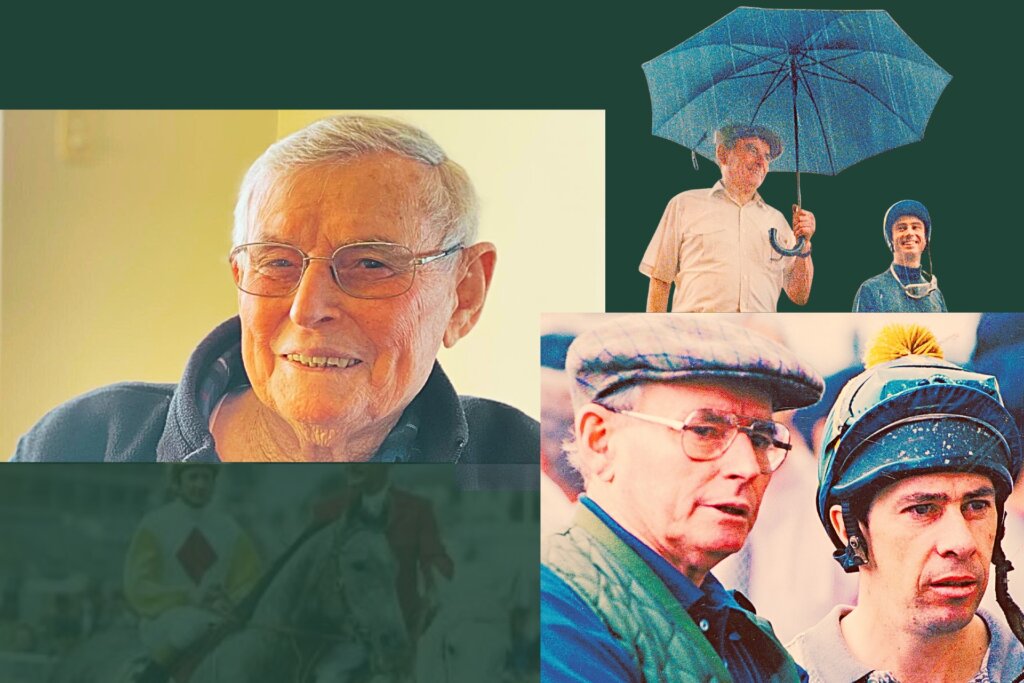
Pride found work with a couple of wise trainers at Rosehill, Barry Lockwood and Bruce Johnson, and then moved to Royal Randwick where he learned from Bill Mitchell. But no one had an effect on him like Size, who later went on to conquer Hong Kong.
“Clearly, he’s one of the world’s best trainers,” Pride says. “I don’t think anyone could argue with that. To be able to work underneath him was pretty amazing.”
Size has never been an extrovert, and even for those who saw him every day, he didn’t speak a lot. Pride would follow him around and just watch, wait and listen for something, anything, to come out of his mouth.
There was far more frequency in the number of new horses which would walk into Size’s complex, failing to reach the (sometimes unrealistic) expectations of their owners who had already tried them with different trainers. It wasn’t an era where horses changed yards a lot. An owner had a trainer, and they generally stuck with them.
But Size picked a couple of older underperformers and suddenly started winning races with them. Pride was puzzled.
“The things he was doing with those horses was incredible,” he says. “One of my favourite ones was Kidman’s Cove. He was a good younger horse who had lost his way, and John got him and turned him around. Within a few months he knocked off Tie The Knot and General Nediym.
“He just did that so many times. I would watch them come in and think, ‘you’re not going to get this one going’. Sure enough, he did. He would just understand the horse.”
Pride only spent four years alongside Size before one day, with little warning, Size told him he was taking up an offer from the Hong Kong Jockey Club. He was gone.
“Here’s a few horses, here’s a few owners, good luck,” Size told him.
Says Pride: “I would talk to him but he didn’t give me many answers. He’s very short, to the point … maybe it’s a good thing. I had to watch and learn and work things out for myself. He wasn’t spoon feeding me information about what I had to do. That’s what made him going away scary.
“It was a scary couple of years. A lot of the time I thought, ‘s—, what have I got myself into?’ I wouldn’t say it was financial troubles, but it was a struggle. There was enough money to pay the wages that week, but if something went wrong, there was no backstop or safety net at all. We got through that, but I wouldn’t want to do it again.”
Perhaps unsurprisingly, Pride has forged a reputation much like his master: a genius at improving horses who have struggled elsewhere. He rarely bothers with imports, and never buys at the top end of Australia’s inflated yearling market, instead building a base of tough locally-bred geldings who can race season after season.
Pride is yet to see a horse he doesn’t fancy he can improve.
“I’m intrigued by a puzzle of a horse and the mystery in getting the best out of them,” Pride says. “I want to work that out.
“Humans are too complex for me to work out. I’m a simple person and I like the fact the horse doesn’t lie to you. The horse is what it is. They react to what you do and you can see the effects of that. When you can get the best out of them, the rest is really enjoyable.
“I’ve only just got there with Ceolwulf. I knew he was a good horse. He won the first two Group 1s and then he had a lean 12 months. But winning the King Charles was such a relief to me. In my head, I knew I had him sorted and then you get to enjoy the rest.”
Pride’s belief in his own ability has manifested itself on social media, where he used to vociferously defend the merits of his own horses and cheekily claim some of his sprinters could beat the likes of Lankan Rupee, Chautauqua and Nature Strip. Sometimes they would, sometimes they wouldn’t. When they didn’t, that was when he would hear all about it.
Maybe it’s the passage of time and getting into your 50s, but Pride is not quite as prolific at baiting others on X these days, which is perhaps a shame given his stable is bursting with talent like Ceolwulf, Private Eye and Godolphin’s recent G1 winner Attica.
He’s even managed to win Australia’s richest race, the A$20 million The Everest, with Think About It, the narrow-chested, wispy gelding who rose to the top in a flash with nine straight wins and almost disappeared just as quickly.
“He had a helluva lot going against him, but we maximised the 12 months we had with him and then he was gone, burnt out,” Pride says. “So, I don’t look at a horse like him and go, ‘should have done this, should have done that’. I feel like we over-achieved with him in some ways.”
Yet there’s one horse which he always thought was the one that got away: two-time Group 1 winning bullet Terravista.
“He was freakish,” Pride shakes his head. “I just couldn’t … I got to the point where I think I knew what happened to him. He got off the track in a lot of his early wins and he would have heat stress and stumble off the track. I think he just burned himself out.
“That was one horse I thought, ‘what could have been?’ Give him to me now, I don’t even know what I would have done different. When a horse leaves the place and you haven’t got the best out of it, there’s no worse feeling.”

Sitting in a portable stable office underneath a picture of Pride’s best horses, it’s hard to imagine someone so young can speak with such wisdom.
Brave Pride is only 19 and already works full time in his father’s stable, but speaks like an industry veteran for decades. Joe never pushed Brave, or his two daughters, to follow in his footsteps.
But for the last six years, all Brave has ever wanted to do was to go to the races on a Saturday. He quit school sport because it was starting to get in the way.
“My hobby is racing,” he says. “I couldn’t imagine doing anything else. None of myself or my sisters had pressure to like racing, it was just around us. How I felt going to the races six years ago on a Saturday, I still feel the same way. I’d rather be at the races on a Friday than be working at home.”
Brave rattles off the credentials of each of the stable’s current, and former, stars. He likes the bread-and-butter horses just as much the Group 1-winning headliners, like Ceolwulf.
On the day of the King Charles Stakes in October, Brave was strapping Coal Crusher in an earlier race and took him back to the stable after the Sydney Stakes. It wasn’t long until Ceolwulf’s turn when he realised he was too nervous to drive home. So, he watched it on his phone in his car.
“I was screaming and banging the window,” Brave laughs. “It’s more the pride and he’s been such a faithful horse. You start to doubt yourself and you hear people tell you he’s not that good. Believing in yourself and getting the job done, there’s nothing more special than that.”
Joe has no immediate plans to include Brave in a partnership, and certainly hasn’t plotted what it will be like when he finally hangs up the binoculars himself. He’s had chances to go overseas before, and has no interest now.
“When trainers retire, you can’t sell the business,” he says. “There’s nothing there. It’s goodwill. Gear and goodwill. I’m not finished yet, but I’ve achieved a lot of the things I’ve wanted to achieve. The industry has been fantastic to me.
“It wouldn’t worry me if I retired and that was the end of Pride Racing, but the thought of someone taking it over being my son, or it could be one of my daughters, that has appeal to me. But I never want it to be at the expense of anything they want to do. It’s got to be quite natural.”
Already, Brave has proven himself to be a natural – and perhaps more than a chip off the old block. Unashamedly, he nominates Coal Crusher as his favourite horse. He knows it’s not the best horse his dad has trained, but it’s his favourite.
And just as he finishes gushing about all the reasons why, he slightly pulls down the left side of his shirt to show something on his chest: a tattoo tribute to Coal Crusher.
He learned from the best. ∎