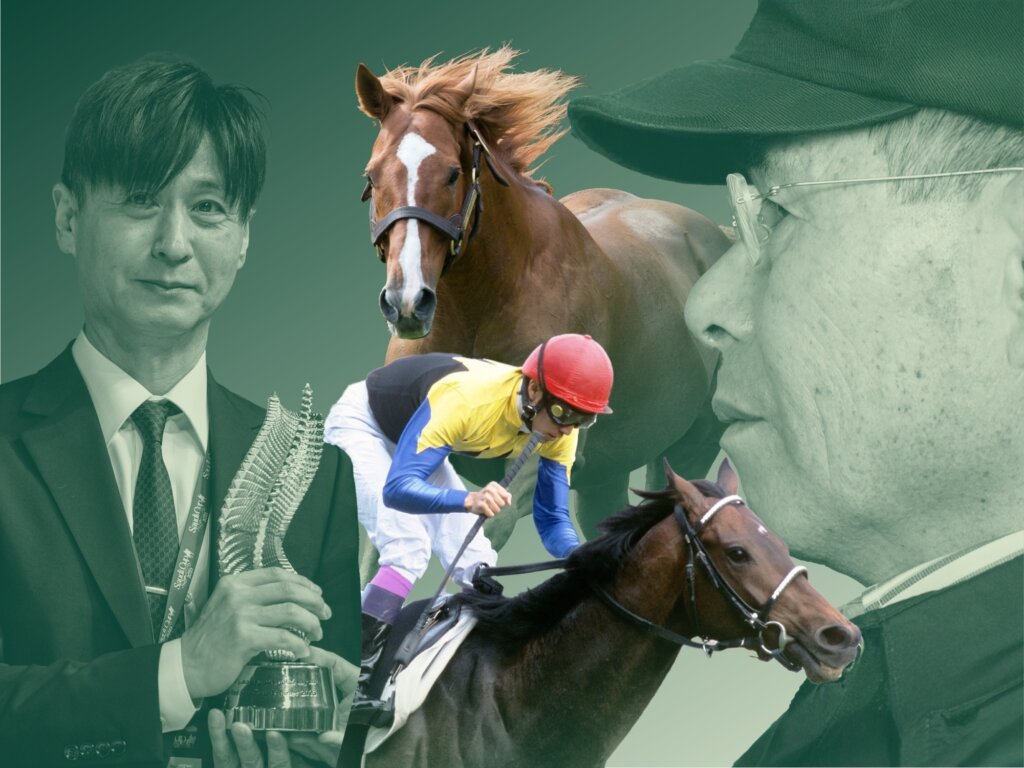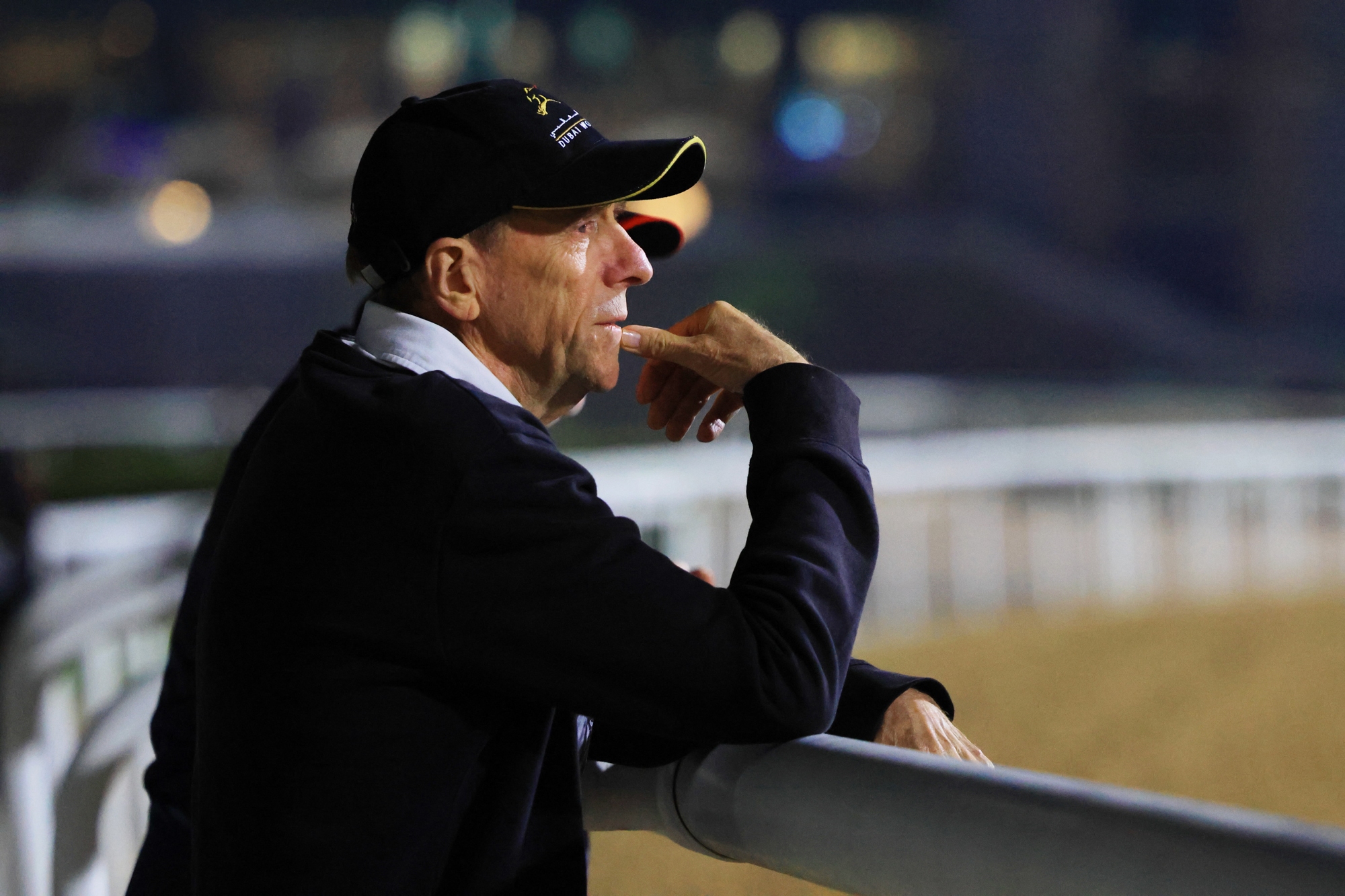
The rain has rolled away over Tai Mo Shan and now mist drifts across Sha Tin Racecourse, softening the hard edges of the grandstand and the stable blocks. Mafoos in hooded raincoats walk horses down the wet asphalt roads. Just outside the office window, a blacksmith taps rhythmically at a horse’s hooves.
Tap. Tap. Tap.
John Size sits in the corner office, looking out of a curved bay window overlooking the yard, not far from the 1800-metre chute and the equine pool that has become one of the trademarks of his Hong Kong career. There are no trophies on display. No photographs. No framed certificates. No sense, really, that this is the workplace of a 13-time champion trainer – perhaps the most successful trainer Hong Kong racing has known.
In front of him, a stack of notebooks and papers. Underneath him, a basic office chair positioned perfectly to watch the stable yard outside. Functional, no fanfare. Like the man himself.
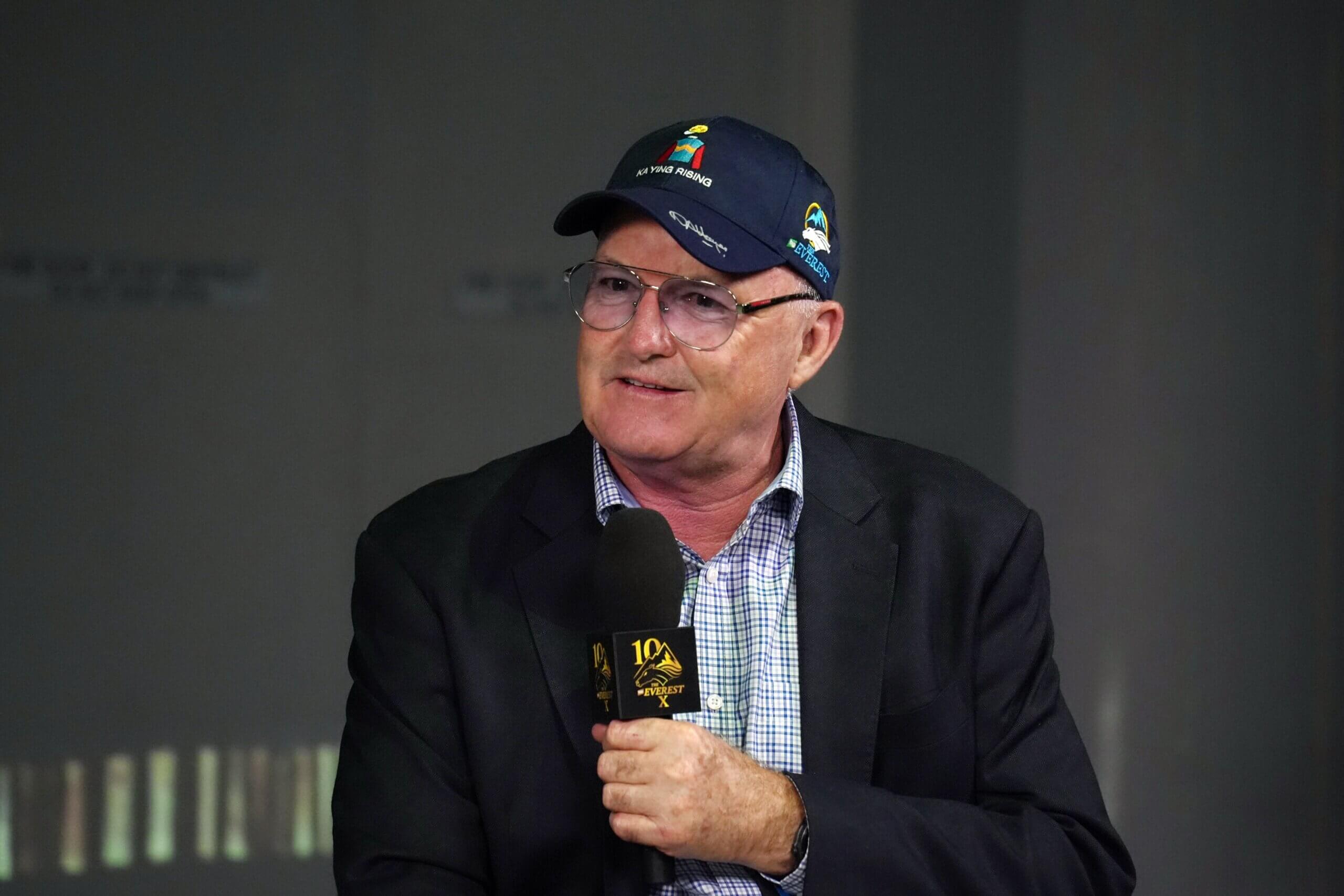
When we visit there are 18 meetings left in the season and around Hong Kong racing there is even more hype than usual about the trainers’ championship. Five men sit ahead of Size in the standings. Caspar Fownes has flown Joao Moreira back from Brazil for the final stretch. Reporters are calculating scenarios, asking trainers to talk about rivalries, pressing for soundbites about the title chase. The narrative is familiar: who wants it most, who is chasing whom, who will crack.
Size barely seems interested.
The five trainers ahead of him have seven championships between them. Size has 13 from 24 seasons. He wins a title more often than he doesn’t. But he does not talk about winning titles. He does not talk about the men ahead of him. He does not talk the way the championship narrative demands.
“If you survive in your job, you’ve got to win and if you win you beat somebody,” he says. “But I wouldn’t think that I’d be thinking about beating my competitor. I want to win the race and I’m intrigued by the path towards winning the race.”
That word comes up often with Size. Intrigued.
Not obsessed, he insists. Intrigued.
Intrigued by process. Intrigued by trying to get a horse to realise its potential. Intrigued by improvement.
“I’m intrigued by trying to get it right,” he says. “Trying to get a horse to do his best to realise his potential. That’s where the process begins and that can become all-consuming.”
He doesn’t want this to be a history story either. For a start, he thinks that would be boring. And more pressingly, he says, he has too much to do today and tomorrow to spend any time pondering the past.
There is something of Wayne Bennett about this. The champion rugby league coach is from a similar part of the world – rural southeast Queensland – and is similarly successful, similarly enigmatic, and similarly single-minded. Ask Size what the secret is, and his answer returns you to the horses, to the yard, to the daily work. Not because he is being evasive. Because, for him, that really is the answer.
For more than two decades Hong Kong racing has tried to understand exactly how Size does what he does. In a jurisdiction where every gallop is timed, filmed and dissected, where veterinary records are public and laps of the swimming pool are counted, the “Size method” has still somehow become part of racing mythology. For all of Hong Kong’s transparency and integrity measures, describing what Size does well remains oddly difficult to pin down.
The great American writer David Foster Wallace once wrote about Roger Federer that the beauty of his tennis was obvious to anyone watching but dissolved the moment you tried to describe it. The harder you looked, the less you could explain. There is something of that quality in what Size does – not as performance, but as mastery. The framework is visible enough. Swimming. Hand-walking. Patience. Slower work. Many barrier trials. Careful race placement. These are not secrets. Anyone with an internet connection can see them.
But the framework alone does not explain the metronome-like consistency – horse after horse, season after season, producing performances at or near their ceiling with a regularity that borders on the mechanical. It does not explain why Luger won a Derby second-up. Or why Ping Hai Star did the same from a series of 1400m races and Happy Valley barrier trials. Or how Glorious Days returned from six months off to demolish an all-star field in the Hong Kong Mile first-up. And it does not explain the numbers.
Size’s career strike rate in Hong Kong sits at 13.6 per cent. It is a number that exists on its own. Among his active championship rivals, as of the start of this season – Caspar Fownes (9.6 per cent), Danny Shum (9.2), David Hayes (8.9), Francis Lui (8.4) and Mark Newnham (9.2).
The only trainer to get anywhere near him is his own former assistant, Frankie Lor, who has a career strike rate of 11.3 per cent and is widely regarded as the closest thing Hong Kong has to a Size disciple. Even Lor’s best season – 90 winners in 2021-22, the year he won the championship – came at a strike rate of around 13 per cent. That is usually Size’s floor. In his peak years of 2016-17 and 2017-18, Size struck at 17.6 and 17.1 per cent – not from a small string, but from more than 500 runners a season. Volume and efficiency. Most trainers can produce one or the other, but Size was doing both simultaneously.
People have written about the framework many times and they get it more or less right. Size has read it. But there are things, he says, that they cannot capture.
Maybe because it is a living, breathing embodiment of horsemanship, earned the hard way, across a lifetime of obsession – or intrigue – with the animal. How do you explain that? How does anyone explain work ethic, or passion, or a curiosity that never dims?
“That can’t be just it though,” I say to him at one point. “What’s the intangible – what are we missing?”
“Well, it’s exactly that, isn’t it?” Size replies. “It’s the intangible. I’m seeing something in a different way, from a different point of view, and it’s not obvious.”
He shrugs slightly when he says it, as though the question itself is impossible. Not because the answer is a secret. But because some things cannot be separated from the person who does them.
Outside the window, another horse passes through the rain.
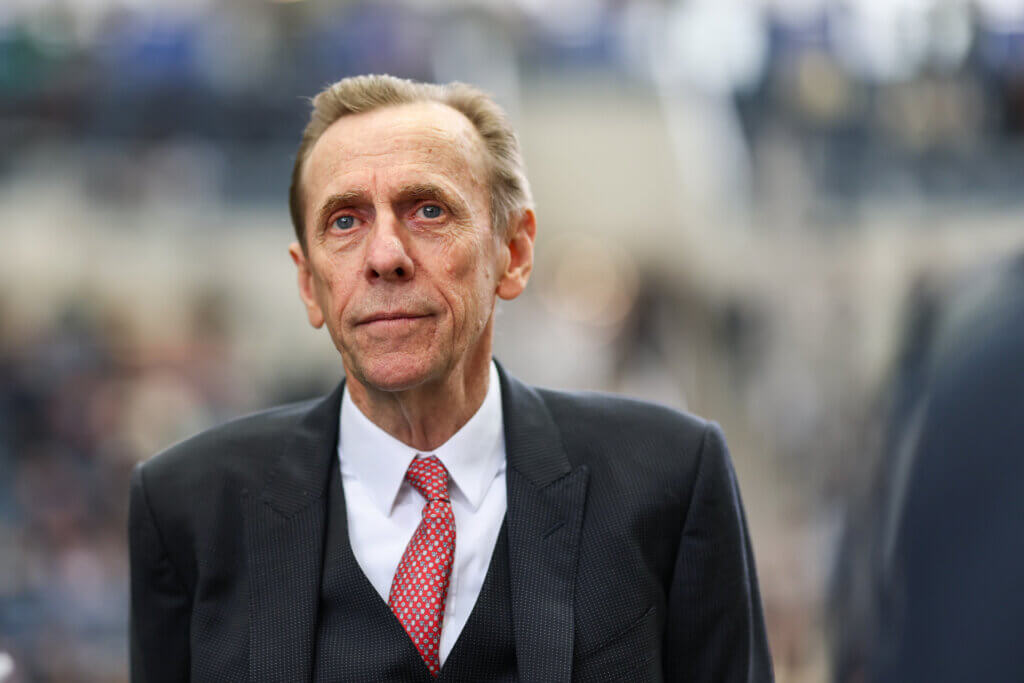
It was not always this way – Size as the serene enigma at the centre of Hong Kong racing. When he arrived from Sydney in 2001, wearing a broad-brimmed hat that looked more at home in the Australian outback than at Sha Tin, nobody knew what to make of him. Then he won the championship in his first season – 58 winners from just 291 runners, a strike rate of nearly 20 per cent from a stable that was still being assembled. And his second. And his third.
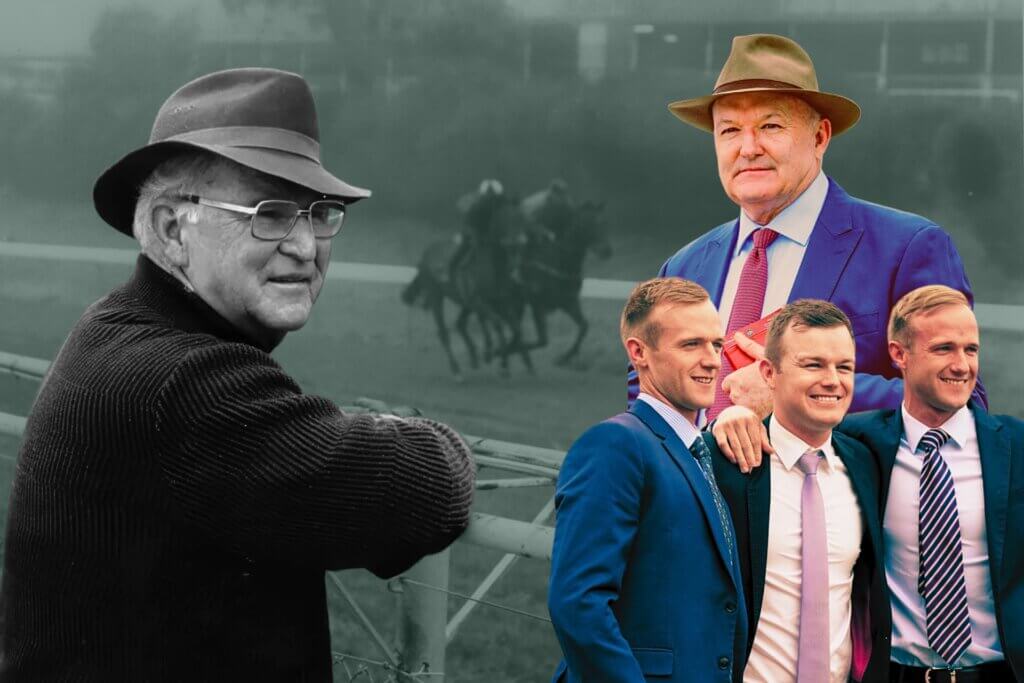
The late Ivan Allan, a wily and experienced trainer, was so unsettled by this quiet newcomer that he was reportedly spotted hiding in the bushes near Size’s barn, trying to observe what was different, what the secret might be. Allan was not a fool. He certainly did not lack self-confidence. He simply could not believe the newcomer could do what he was doing without assistance. Those rumours would follow Size at the start, both in Sydney and Sha Tin, but soon faded.
Size has watched others arrive since then – overseas trainers, confident and credentialed, certain they can crack the Hong Kong system by imposing their will. Some do well enough. But the system has its limitations, and it has a way of humbling those who believe they can simply transplant what worked elsewhere. Hong Kong is hyper-regulated, hyper-transparent, and unforgiving. Every action gets a reaction, Size observes. You had better know what the consequences are before you get any fancy ideas about how you are going to change things.
The ones who last are the ones who adapt. Size adapted 25 years ago and has never stopped adapting since.
The temptation to describe Size as obsessive persists, but he pushes back on that. Even now, after reshaping Hong Kong training methods and winning more often than not across a quarter of a century, he talks less about ambition than concentration. Less about goals than daily observation.
Asked directly whether ambition means anything to him, he concedes that it does. “I think I’ve always had some ambition,” he says. “I couldn’t deny that.”
But when pressed to describe it – what he saw when he set out, what he wanted – he pulls back. “No, I don’t think I could describe it,” he says. “I couldn’t say that my ambition is driven by X. I wouldn’t know how to articulate that. I couldn’t tell you.”
It is a revealing admission – not because it suggests a lack of ambition, but because it mirrors the intangible that defines his training. The skill cannot be separated from a lifetime spent acquiring it. The ambition cannot be described because it was never really ambition in the conventional sense – it was something more like total absorption.
He is not a goal-setter, he says. “I wouldn’t be the sort of person that would set a goal.”
On paper, Size’s record suggests a competitive beast. In 24 completed seasons, Size has finished in the top three of the trainers’ championship 21 times. Thirteen titles. Five seconds. Three thirds. His two worst seasons – 32 winners in 2006-07 from a reduced string, and 46 in 2019-20 – were followed by a championship win and a runner-up finish, respectively. The dips don’t last – the metronome resets.
Murray Bell, the former South China Morning Post racing editor and one of the sharpest observers of Hong Kong racing, once told me that Size’s greatest attribute was his ability to focus on one thing, for a long period of time. Size neither accepts nor rejects the observation. “That’s something I wouldn’t have to try to do,” he says. “It’s already there.”
And perhaps that is the closest thing to a key that Size will offer. Not ambition in the loud or theatrical sense. Not targets, not benchmarks, not the relentless scorekeeping of modern sport. Just immersion. Total and unbroken immersion in the daily process of preparing horses to produce their best in a race.
At one point, while talking about blacksmiths and horseshoes, Size gestures towards the farrier outside.
“My man is tapping my horse’s feet and his shoes and he’s doing this and doing that and I’m going to be with him,” he says. “I want to see how that horse is reacting to what we’re doing.”
It sounds simple when he says it, but that is the point. The simplicity is not a deflection – it is the whole story. A lifetime of paying this kind of attention, with this quality of focus, accumulates into something that looks from the outside like a method and from the inside – to Size – like just showing up.
He is puzzled, sometimes, by the media’s fixation on personalities. Why, he wondered out loud on our way to the yard, do journalists not write about horses more? The question might sound flippant but he means it. In his worldview the horse is the centre. The trainer, the jockey, the championship narrative – all of that is peripheral. Background noise.
This is partly why Size has always been an uncomfortable fit for the stories others want to tell about him. The championship storyline needs rivalry, ambition and hunger. Size offers process. Reporters want theatre. He gives them observation. The industry frames five trainers as his competition. He frames the competition as something internal – between what a horse has done and what it might yet do.
Nobody is in a race with John Size except the horses in his care.
A reporter from one of the local newspapers has been badgering Size for months now, looking for a championship soundbite – something combative, something quotable, something that fits the narrative. Size will not bite. He does not see the point. The championship is there, he acknowledges, but it is not something he goes looking for.
“You don’t get out looking for it,” he says. “It just happens to be there and it’s part of your job, part of your living, part of what you do. And basically I think everyone’s in some sort of competition, I suppose, no matter what you’re doing. But it’s just not so public.”
In a previous conversation, Size put it more plainly. “I don’t see myself as being in competition with the other trainers,” he said. “I am in competition with myself – but I think that is anybody in competitive sport really, and anybody in life. You are striving for a personal best. As a trainer, we are trying to get the best out of these horses and bring them home safe.”
That last phrase – bring them home safe – is not a throwaway. Size has been known to retire horses early when they suffer a bleed or a heart irregularity, pulling them from competition before the system demands it. It is a decision that costs winners and prize money in a jurisdiction where both are currency, and it has not always been popular.
“I’m sure people have said I’ve retired horses too early,” he says. He does not sound troubled by it. He sounds like a man who made the call and moved on.
It is the tension at the heart of what Size does. He operates inside a competition but does not think competitively. He is measured by winners but measures himself by something else – whether the horse did its best, whether the process was right, whether the animal came home in one piece. The scoreboard is someone else’s obsession.
Consider this current season. Through March, Size had 32 wins and 43 seconds – more runners-up than victories, a near-miss rate that could crush some trainers. Then came a four-timer at Sha Tin in April that pulled him to within nine of the leader, because Size’s seasons do not follow the same arc as other people’s. His competitors start fast and try to hold on. He starts slow and builds. The surge always comes. It is unlikely that 12 meetings is enough time for the pattern to hold this season, but there is always next year.
He grew up in Dalby, in the rural southeast of Queensland. The son of a service station owner. Horses were there from the start – an intrigue, he says, using that word again, that has never faded.
“I didn’t want to do any history,” he says of his background, “but I was intrigued by horses. I still am.”
That is all he will offer about the beginning. There is a longer story – the teenage growth spurt that ended an apprenticeship, the years with Pat Duff and the legendary Henry Davis, the move to Randwick, the broad-brimmed hat on day one at Sha Tin. But that story can wait. Size has made it clear: he has too much to do today and tomorrow.
When asked whether he allows himself satisfaction after great victories, he pauses.
“There’s always some sort of short thoughts like, could he have done better?” he says.
And after the biggest wins? The famous Derby wins? The Hong Kong Mile?
“Yeah, of course,” he says. “At least half an hour before you train another beaten favourite.”
He smiles faintly.
That is the Hong Kong system – turnover-driven, relentless, a new race meeting always approaching. But it is also just Size. Satisfaction is a brief pause between questions. The process resumes, because for him the process never really stops.
Outside the window, the farrier keeps tapping away in the mist.
Size turns back to his notebooks. More than 1,600 Hong Kong winners trained, 77 behind his retired rival John Moore (1,735) at the time of writing. The efficiency. The relentlessness of doing it well, year after year, with no noise and no trophies on the shelf.
In his 25th season there are five trainers ahead of him. The championship chatter will continue. Reporters will probably still keep asking questions about the championship he does not care to answer.
He has horses to watch. ∎