Ethan Brown Could Not Watch A Race – Now He Is Ready To Jump The Fence
Trauma, patience, and what it really takes to come back – the journey that brought Ethan Brown to Happy Valley and a handshake he will never forget.
Ethan Brown Could Not Watch A Race – Now He Is Ready To Jump The Fence
Trauma, patience, and what it really takes to come back – the journey that brought Ethan Brown to Happy Valley and a handshake he will never forget.
21 April, 2026ON A CLEAR NIGHT in Alice Springs the stars are extraordinary. Out where the red dirt stretches to every horizon and the nearest city is more than a day’s drive in any direction, the sky does something it cannot do anywhere with streetlights or stadiums or the competing glow of human ambition. It simply opens. Vast and silent and indifferent to whatever is happening beneath it.
Ethan Brown grew up under that sky, in the dry heat, in a small town where everyone knows everyone and hard work is all that counts. It is about as far from here as it is possible to get.
‘Here’ is Happy Valley on a Wednesday night – the most dazzling rectangle of real estate in world racing, a track so compressed by the city around it that on one side the grandstand seems to lean in over the home straight. On the other side the tower blocks are stacked against the dark sky and form their own man-made constellation. The compressed electricity of fifteen thousand people and some of the world’s best jockeys in the tightest urban racing cauldron on earth.
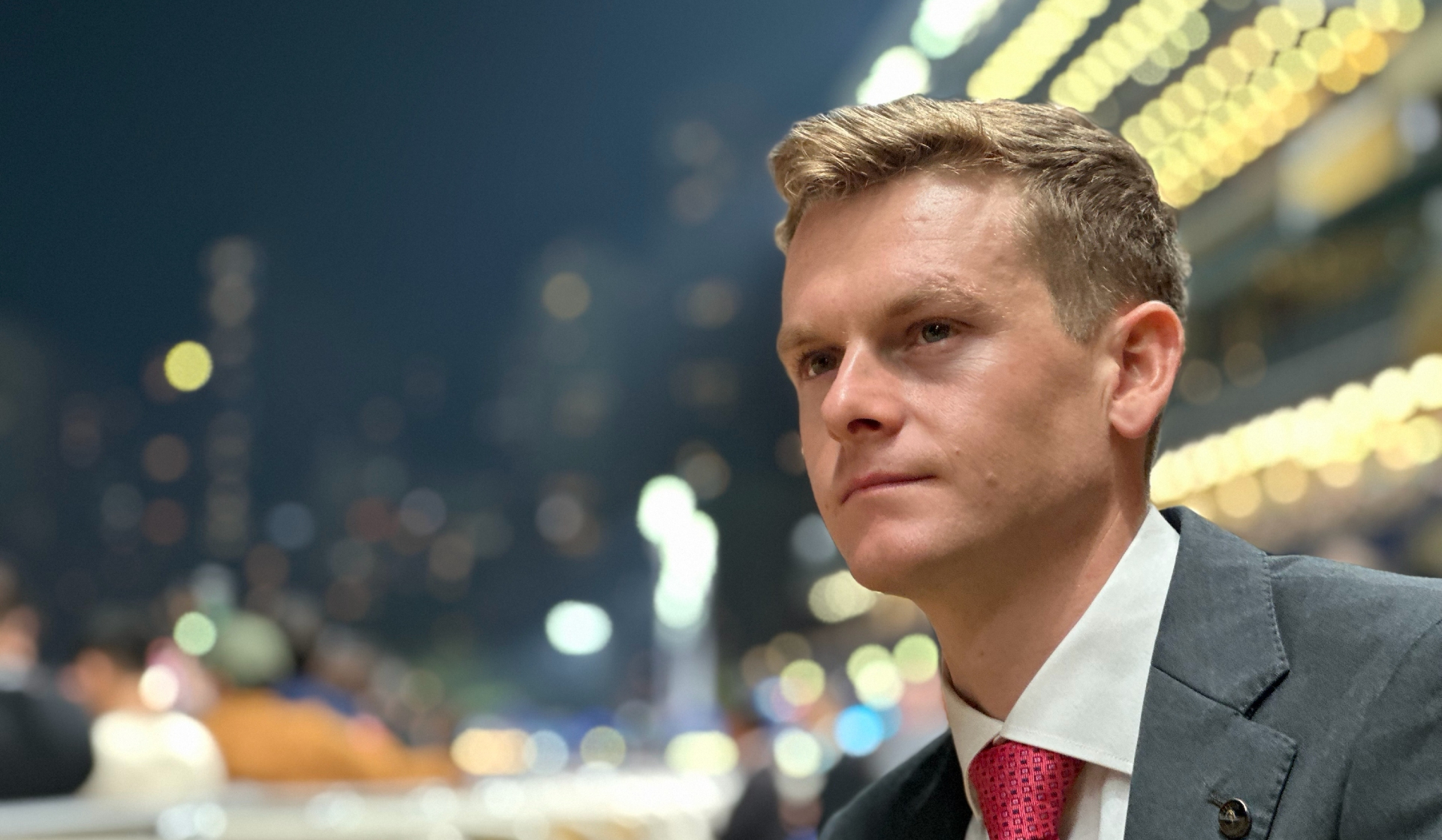
The horses are coming out now. One by one they emerge into the pre-parade ring, led by their mafoos and swallowed immediately by the atmosphere. The horses move past – coiled, alert and reading everything. Ethan Brown, a long way from Alice, watches from the rail on the outside.
He cannot ride tonight. It is mid-March, and, suspended in Melbourne, he turned the enforced break into something useful, as he tends to do with difficulties. He flew to Hong Kong for a reconnaissance mission to ride in barrier trials and study form, a month away from his late season stint. He is a student by nature, a watcher, someone who needs to understand a thing before he does it.
This night, he looks ready to jump the fence.
“I cannot wait to get out there,” he says, and you believe him completely. “I’m chomping at the bit even harder than I was.”
Consider, then: not so long ago Ethan Brown could not bring himself to watch a race at all.
Red Dirt
Alice Springs is a long way from here.
Not just in distance, though the distance is real enough – desert country stretching three thousand kilometres between the town he grew up in and the nearest metropolitan racecourse in Australia, let alone this luminescent cauldron on the edge of the South China Sea.
“Red dirt, dry,” Brown says simply. “Mum had a basic government job. My dad was an electrician. Horses weren’t a big part of our family.”
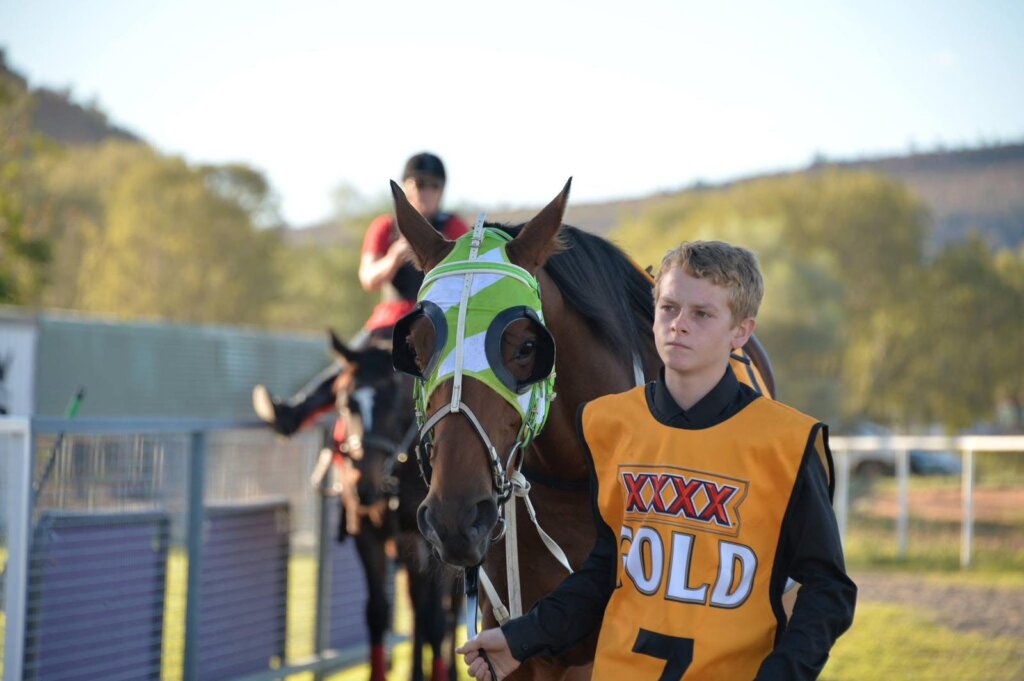
He was always small. People would tell him he should be a jockey. At fourteen someone legged him up on a horse for the first time at a local trainer’s yard, where he had been mucking out boxes and doing the waters before and after school. At the time it did not feel like destiny. The first time they put him on the actual track the horse bolted. Four laps, flat out. He could not pull it up.
“I couldn’t feel my arms for about a week.”
He is grinning now. That is the thing about Ethan Brown and adversity – he grins at it, eventually. It just sometimes takes a while to get to the grin.
The Gap Between Two Worlds
The Cranbourne trainer Mick Kent is a racing obsessive of a particular and total kind. Brown was fifteen years old, fresh out of Alice Springs, a country kid who had never lived anywhere but home when he moved south to live with Kent. The gap between those two worlds was considerable.
“He is super serious about horse racing,” Brown says.
But what Kent gave him, beyond the technical education – the hands, the race-reading, the positioning, the relentless attention to detail that would eventually make Brown one of the most complete young riders in Australia – was something harder to quantify. When the homesickness inevitably came, when the weight of being fifteen and alone and far from everything familiar became too much and Brown wanted to stop, Kent guided him through it. He let him go home to ‘The Alice’, but was always in contact. Always pointing in the right direction.
“He guided me all the way through. Always there for me no matter what.” Kent has produced champions before. Craig Williams came through his stable. Beau Mertens. Jake Bayliss, who became one of Brown’s closest friends and housemates through those difficult early years. There is a particular kind of trainer who understands that making a jockey is not only about making a rider. Kent is that kind of trainer. Brown’s mother Sonia, who cried for weeks after her son left Alice Springs at fifteen, put her trust in him early. “I was not going to hand my son over to just anyone,” she told journalist Kristen Manning for a story in Thoroughbred Racing Commentary. “Mick has been amazing. He helps Ethan not just professionally, but emotionally.”
It is the kind of thing you hear about Kent from those who know him. And it is, perhaps, why Ethan Brown is standing here tonight instead of somewhere else entirely.
Three Hundred Metres
By March 2023 he was riding the best racing of his life.
Sixty-two Victorian winners for the season. Four hundred career wins just ticked over. At 23 he had already done things that riders twice his age had not. The Australian Guineas at Flemington on the fourth of that month was just another Group 1, just another Saturday, just another race.
Maximillius hit the ground at the 300-metre mark.
Brown went with him.
He did not lose consciousness. That is the thing that made everything that followed so much harder. There was no merciful gap in the memory, no blackout, no moment where the mind did what it sometimes does and simply stops recording. He remembers all of it. Every second from the moment the horse fell beneath him to the moment they loaded him into the ambulance, the pain already arriving in waves, the knowledge already forming that something was very wrong.
Brown lost five and a half litres of blood. The human body carries six and a half, seven at most.
Three surgeries in as many days. A grade five lacerated liver. A severed artery. A damaged kidney. Hairline fractures in three lower vertebrae. Three days in a medically induced coma in the Royal Melbourne Hospital intensive care unit, his partner Celine Gaudray and his mother Sonia by his side, waiting. He even lost his voice for a month. The surgeries and severe blood loss had taken that too.
The racing world held its breath. And then, because cameras were rolling at the Royal Melbourne Hospital for a television documentary series, millions of Australians would eventually watch some of what happened in that emergency room – a 23-year-old jockey fighting to stay alive after a Saturday afternoon at the races. The gap between the spectacle of the sport and the reality of what it asks of its participants, laid bare.
Five weeks after the fall, he sat in a room with a Racing Victoria steward and watched the replay as part of the official inquiry. He was, by his own account, in more shock than he had anticipated.
“I still remember the fall itself and the pain. I never knocked myself out. So that’s what made it so hard in the first place to come back.”
The Shape Of It
He came back that August. Five months after the fall, faster than anyone had expected, and faster perhaps than was wise. When he resumed race riding at Sandown, the racing world exhaled with relief and called it a miracle.
It wasn’t a comeback. Not yet.
“I came back, I had four months, I reckon, then I thought – this is too soon. I’m not ready for this.”
In October 2023 he stepped away again, this time with a statement more honest than the racing world is accustomed to hearing:
“I thought I was ready to make my comeback. I worked extremely hard behind the scenes to get back in the saddle. However, I underestimated how much self confidence, self belief, dedication and determination it would take to get me back to race riding at the level I was at before the fall.”
What he did not say publicly – what he is only beginning to speak about now, standing under the Happy Valley lights with the horses filing past – is what those months were actually like.
The PTSD. The anxiety. The weight that came on, the body doing what bodies do when the mind cannot process what happened to it. The qualities that had made Brown exceptional as a rider – the instinct to override pain, to push through, to never show doubt in the saddle – were now working directly against him. He had spent his whole career learning to suppress the signals his body sent. Now those signals were the only thing worth listening to.
And Celine – his partner, also a jockey – pulling on her silks every day and going to the races while he sat with it at home.
“At the start I couldn’t even watch races … I couldn’t even watch. I would watch it and think – nope, I do not want anyone to go through what I had gone through. Especially with Celine. She was riding. And I could not watch her.”
That was the shape of it. Not just a sport he could not face – the person he loved, doing the thing that had broken him, while he watched from the outside. He had good people around him. Family, friends and Celine.
“I probably wasn’t the easiest patient. You sit around, you get depressed, you get sick. You just get sour on the world.”
He got through it. The courage to walk away, it turns out, was what saved him.
“I got stronger from it. You learn from it. And I think you become a much more grateful person. Coming so close to losing it all.”
There is a way that people who have come through genuine darkness speak about it – not dramatically, not with performance, but with a kind of settled clarity, as though the experience has burned away everything that wasn’t necessary and left something cleaner behind. Brown speaks about it that way. He is not telling you he suffered, he is telling you he came through.
“To come out the other side it was just a matter of waiting for my body to tell me,” he says. “I wasn’t forcing it. One day I got up and thought I want to ride again. Started from there. It was just patience.”
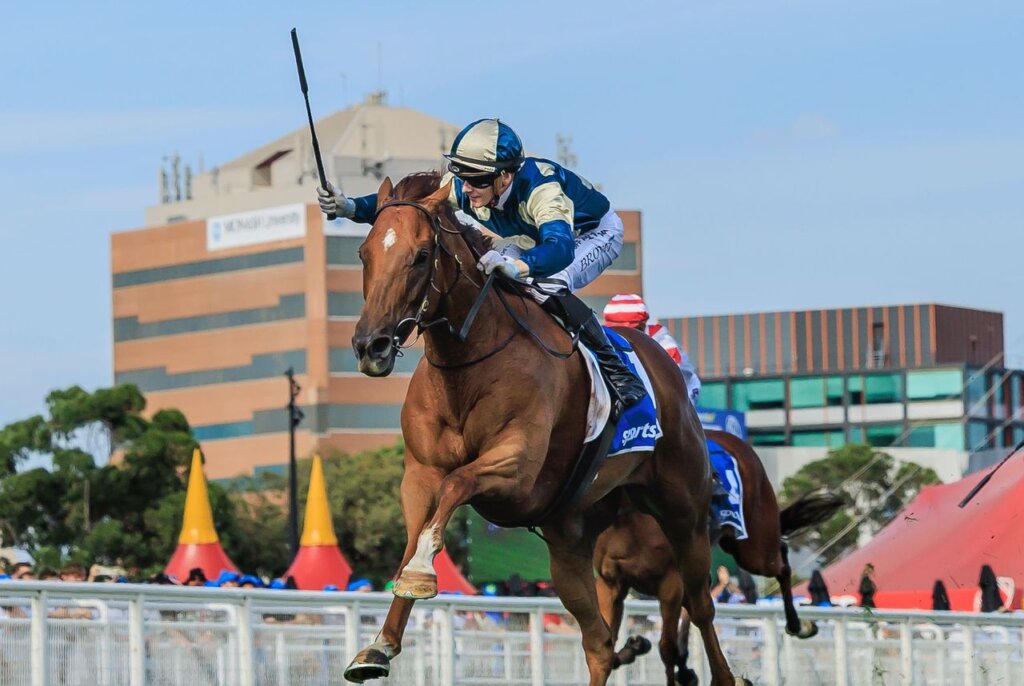
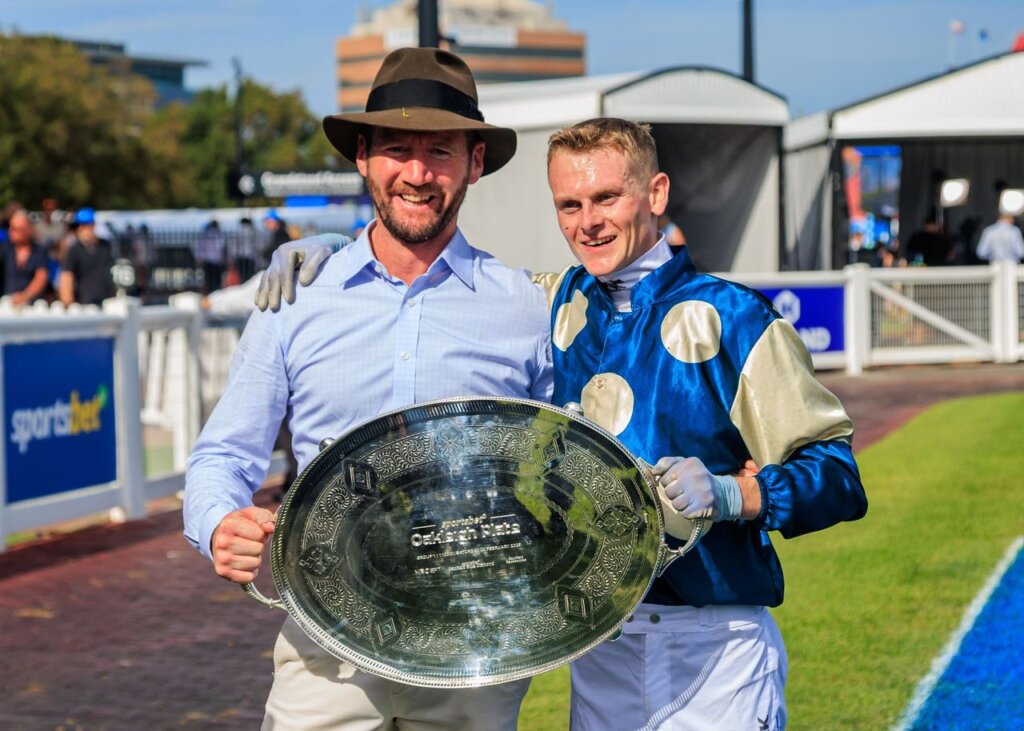
He returned in January 2024. Three Group 1 winners in a single spring carnival. Third in Melbourne’s jockey premiership. Then Hong Kong rang.
Welcome To Hong Kong
Happy Valley is doing what it does – noise and light and the electricity. The horses out behind the gates now, the race approaching.
That day a story appeared in the local Chinese language press. The next young Australian came to conquer, they said. “Ethan Brown wants to be ‘Purton 2.0’.” The headline took a generous mention of Purton’s name – offered in the spirit of respect, not ambition – and turned it into a declaration he never made.
Brown sets the record straight.
“No. I can’t be put in that category at the moment. I’m just coming here to do my best. I’m not going to compare myself to anyone. I’m purely here to get an education out of it.”
There is a humble ambition in that answer – he would not be here otherwise – but there is something harder-won than ambition in the way he says it. Something that sounds like a man who has learned, the difficult way, not to run ahead of himself. To wait for his body to tell him. To let things come.
He is 27 years old and he already knows things about himself that most people spend a lifetime avoiding.
Brown is mid-sentence when a figure approaches from the direction of the parade ring.
Straight backed, unhurried. A face that anyone who has followed Hong Kong racing for the past quarter century will know without being told.
He extends a hand.
“Ethan? Douglas Whyte. Welcome to Hong Kong.”
As if the introduction were necessary. As if the kid who grew up watching Hong Kong racing on a television in Alice Springs – nine years ago, an apprentice in Melbourne catching his first glimpse of what this sport could be at its highest level – needed to be told who this man was. Thirteen consecutive championships. 1,813 winners. Arguably still the greatest jockey this city has ever seen, now a trainer. Brown shakes the hand. From Alice Springs to Happy Valley, from a sand track where a horse once bolted and he couldn’t feel his arms for a week, to this firm handshake.
“Welcome to Hong Kong.”
The horses are loaded. The barriers spring. The new race begins. ∎