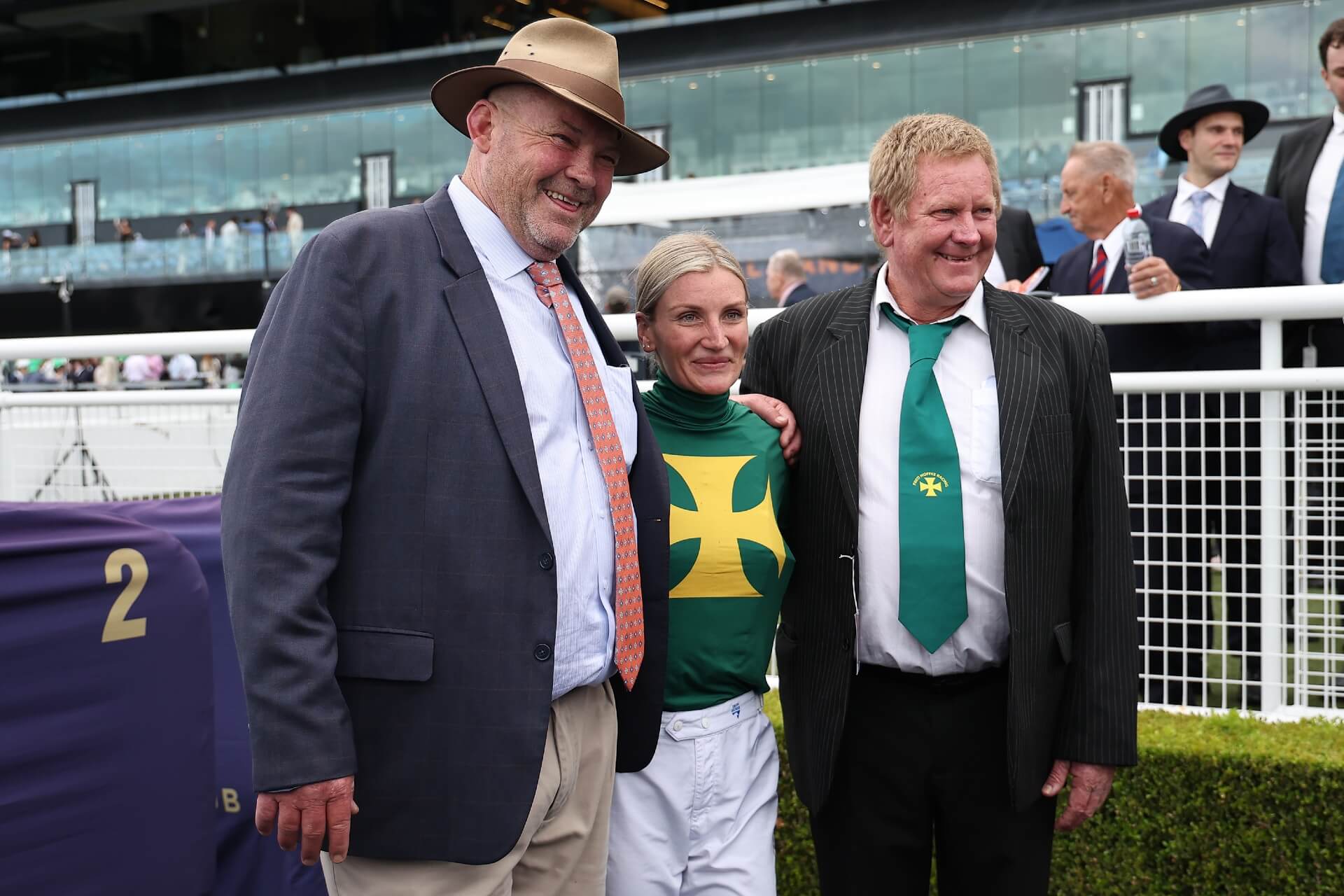
If you’d walked onto Royal Randwick on the opening day of The Championships and were asked to spot the person who most looked like a Queensland grazier, it wouldn’t have taken long.
Living off the land is a tough game, which is why it has long been wedded to horse racing, where the hours are also insufferably long and success can be fleetingly short. There’s always been a special place for ‘bushies’ who make it big in the big smoke with a special horse.
One of them thinks he’s got a good horse, but he’s about to find out. His tie, splashed in the family’s green and yellow colours, is slightly askew. Doesn’t matter. He wears a crisp white shirt with an open collar underneath a pinstriped suit, and the top button looks no chance of being done up. Not today, not tomorrow, probably not ever again. If it was a stuffier race club in another era, he might not have even been let into the privileged areas. But now? Who cares? He’s trying to make himself as comfortable as he can in a very uncomfortable environment.
“I’ll never go to the Melbourne Cup as there’s just too many people,” Fred Noffke laughs to Idol Horse, the Queensland grazier crashing his way to the winner’s room through a sea of backslappers like an amusement park dodgem car.
A few minutes earlier, he was leading his A$10,000 horse Sheza Alibi back to scale after winning the A$4 million Doncaster Mile, one of the most historic races on the Australian calendar.
The filly’s jockey, Jamie Melham, had starved to ride the horse at 49kg under handicap conditions. As Noffke sidles up beside her and the little horse, she can do nothing more than shake her head in sheer disbelief.
It wasn’t a surprise Sheza Alibi won the Doncaster, because after all, she did start an odds-on favourite. With a feather weight on her back, many figured it would only be bad luck or bad management that could trip her up.
As the field turned into the home straight, it was easy to say it might have been a case of both.
Sheza Alibi and Melham had been shuffled so far back and wide, the pair were last. No horse wins from there in a race like the Doncaster, where the handicapper theoretically tries to have each horse finish across the line as close together as possible.
But maybe we haven’t seen a horse like Sheza Alibi before.
Wearing blinkers, the cupped eyewear designed to focus a horse on what’s in front of them and not beside them, out of the very corner of your eye you could see Melham’s trademark white gloves tighten the reins, then shake the little filly up as she angled to the extreme outside, a path she had to take either out of desperation or desire. Maybe she only knows which.
It worked. Too often, a horse which lets down quickly and eats up the grass in front of them is described as a rocket. It’s a cliché which has long worn off its use-by date.
But this was a rocket, Sheza Alibi sprinting from near last to first in the 16-horse field within a furlong. She won by more than four lengths, breaking horse racing’s internet and every Australian database in the modern era.
Bruce McAvaney, the doyen of Australian sports broadcasting who has almost literally seen it all, is moved to say: “We’ve all had the experience of something that takes you to another place.”
Sheza Alibi was it.
Mercilessly, Melham is handed a drink as soon as she completes her official protocol on the scales, having shed three kilograms from an already slender frame in 10 days to ride Sheza Alibi.
Was it worth it?
“I’d be starving every week if it meant I could ride her,” she quietly tells Moody, his training partner Katherine Coleman and Noffke in a team huddle after the race. “I’ve never sat on a horse that has given me goosebumps like that before.”
WHAT HAVE WE JUST SEEN 🤯
— 7HorseRacing 🐎 (@7horseracing) April 4, 2026
SHEZA ALIBI WITH ONE OF THE GREATEST DONCASTER PERFORMANCES IN HISTORY.@jamieleemelham @moodyracingpgm @kscoleman pic.twitter.com/qjYUyqhfY1
By the time you catch up with Moody in the bowels of Royal Randwick’s Queen Elizabeth Grandstand, he still can’t quite comprehend what just happened.
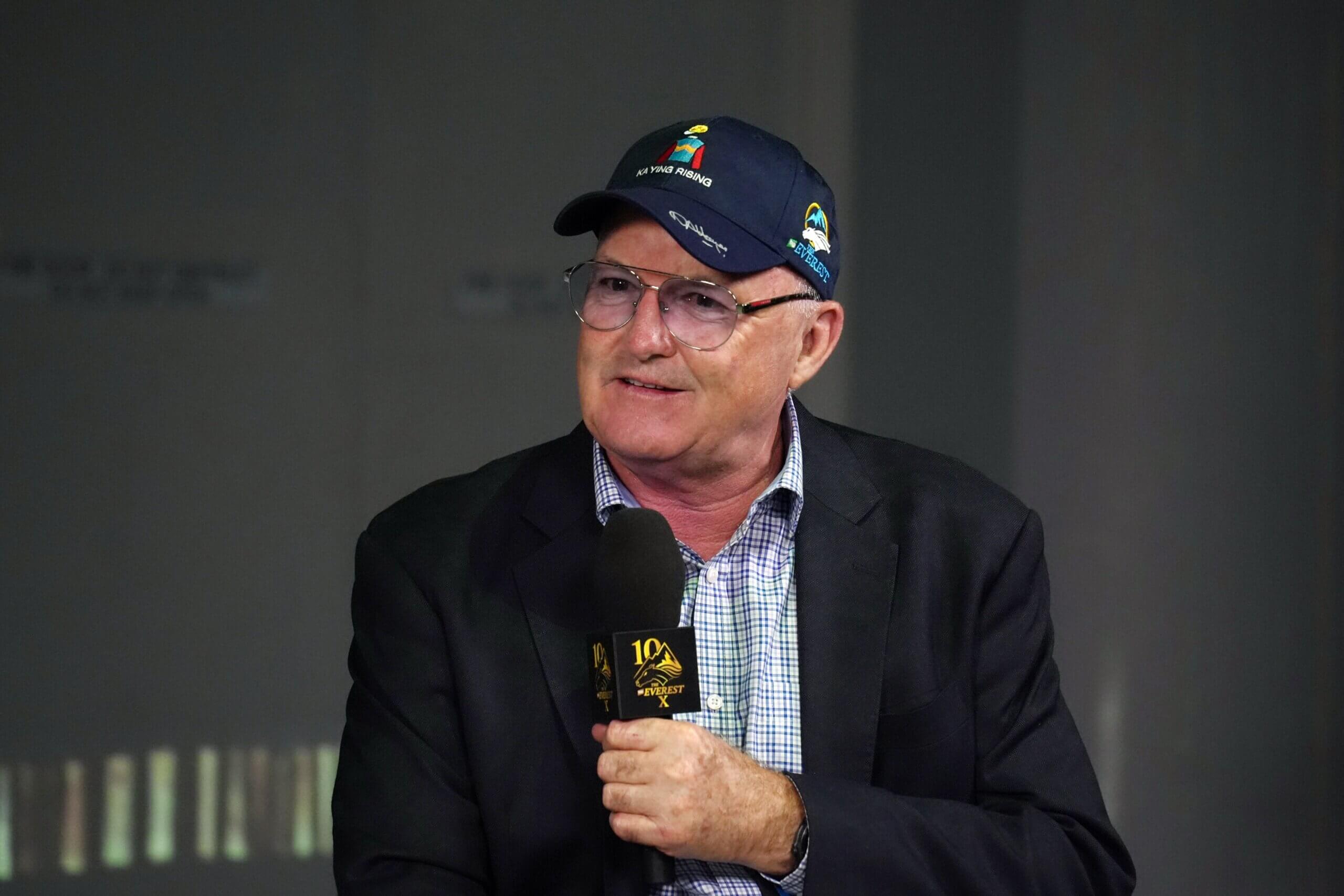
He’s no stranger to training champions. Black Caviar was unbeaten in 25 career starts and did what is less done these days, taking the sporting route and travelling to win at Royal Ascot.
“It was breathtaking and quite amazing,” Moody says of Sheza Alibi. “There’s a few there like the Super Imposes that used to break my heart (in Doncasters), but it’s quite amazing. I haven’t had time to take it in, but she’s something special.”
So, what makes Sheza Alibi so good?
“Listen, I don’t think I’ve identified that yet,” Moody shrugs. “She’s just got a helluva lot of ability, a beautiful deep girth, a lovely hip and she’s very modest. There’s nothing that stands out about her.
“She’s just an unbelievable galloper.”
There comes a time in a country as proud of its racing history as Australia that the best of the best don’t necessarily belong to their owners or trainers, but they start being claimed by the people. A horse which belongs to the country.
Makybe Diva was one. So too, Moody’s Black Caviar. In a weaker moment, he once described training her as a “deadest pain in the arse”, such was the adulation and the piece everyone wanted of him. Winx went there too.
It’s far, far too early to suggest Sheza Alibi will even get close to that pantheon, but she has a story which is worth telling and will resonate with the country.
Noffke reckons he has lost close to $1 million on buying and trading horses in recent years. His days are usually filled with vast, empty, drought-prone lands in the central part of the Australian state of Queensland. The closest town is tiny Goovigen, where shopfronts are boarded up. At last count, the population was 349. Noffke runs more cattle on his farm. It’s close to 2000 head, and even he will admit the cows have served him well.
But there was also an attraction to racehorses, a distraction from an isolating life. His father, Fred Snr, had also raced gallopers in the green colours with a yellow Maltese cross. When Fred Jnr started racing his own horses, he was told he couldn’t use his father’s colours, so he designed his own, which were almost identical bar the yellow armbands. When he won his first race in regional Queensland, Fred had one horse in his colours, and the other in his father’s. No one said anything to him, and he’s proud he got the chance to do it.
During the depressing days when the COVID pandemic was at its peak, Noffke thought he would buy a few more racehorses. He started dabbling in online sales and figured he would follow a pattern.
“Mostly, someone describing the horse, like the breeder,” he laughs when asked what prompted him to buy certain types.
He found a filly from the Japanese-born stallion Saxon Warrior out of a mare called Sheza Gypsy. He didn’t much care for the pedigree, only what people were telling him about the horse. He decided to make an offer and came away with the horse for next to nothing.
“People are a little bit too conservative,” Noffke says. “I don’t know what it is. But no one gets rewarded for taking a risk. If you fail, you’re a goose.”
He took a risk and, on her first start in a maiden race at Rockhampton last year, she couldn’t even win in a five-horse field.
“How did she get beat? They ran a benchmark 78 time,” Noffke says. “Isn’t that a good reason to be beaten in a maiden? That was the first sign. We lost on the day, but we knew we were going to win. I knew she was going to be very special.”
As is the way when horses reach a certain level trained out of regional Queensland, Noffke knew he needed to find a bigger trainer in Sydney or Melbourne for Sheza Alibi to reach her potential. He’d never had the chance to go to Melbourne with a racehorse, so he rang Moody, another Queensland bushie who hailed from the much larger Charleville. Its population is 3000.
“It’s probably why he contacted me, a couple of old Queensland bushies,” Moody says.
“We had a look at it. Jeff (O’Connor), my racing manager, went through it and the worst scenario we thought was, ‘oh well, she’ll be a nice three-year-old filly in Saturday grade. We’ll see what happens’.
“We never dreamt of that.”
As he nods back to the racetrack, it’s hard not to ask Moody if he’s plotting a clash with the unbeaten Autumn Glow, Australia’s weight-for-age standard bearer unbeaten in 11 starts.
“Oh, I don’t know,” he says, before accepting more congratulations from passers-by.
It’s unlikely to happen any time soon. There are other lucrative options.
Ever the hands-on bushie, Moody drove the horse truck back from Sydney to Melbourne himself – the stable’s star, now worth considerably more than A$10,000, in his rear vision mirror for the near 1,000 kilometre trip – but you get the sense this journey has only just started.
Sheza Alibi will be set on a path towards the A$10 million Golden Eagle in Sydney during the spring, the same race Autumn Glow won last year. The Golden Eagle is restricted to four-year-olds. Autumn Glow’s trail will probably lead to the Cox Plate.
Eventually, Noffke might get to the same race with a horse good enough to take him to Melbourne.
And if you walked onto a new and redeveloped Moonee Valley in 2027 and had to find the Queensland grazier, it shouldn’t be too hard to do. Just look for bloke with the tie a little off centre, rocking the open collar – willing to take a risk when others aren’t. ∎